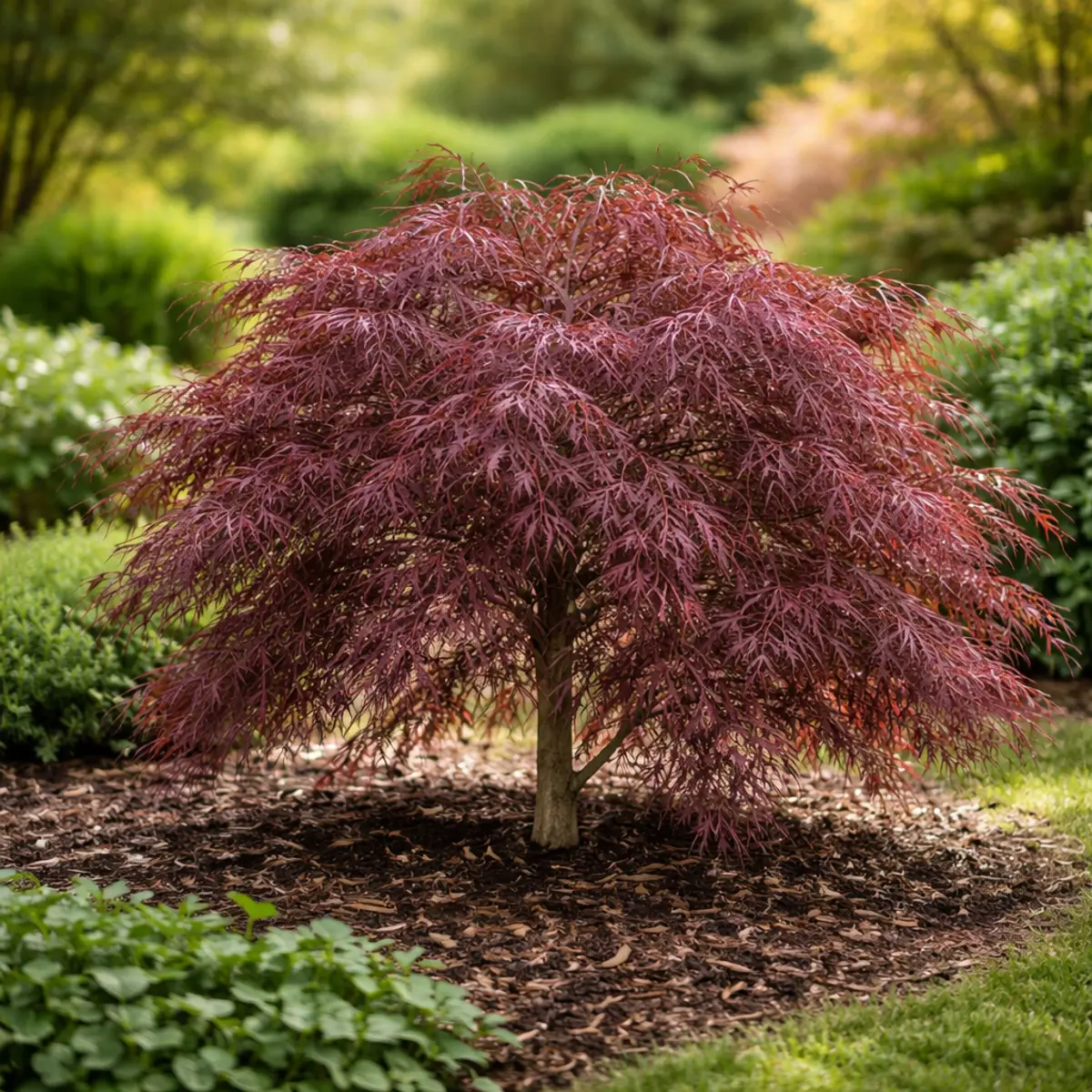
Japanese Maple 'Crimson Queen'
Acer palmatum 'Crimson Queen'
A compact, weeping laceleaf maple with deeply dissected crimson-red foliage that cascades in a graceful mound — one of the most ornamental small trees for a garden.
Keep reading Show less
Acer palmatum ‘Crimson Queen’ is a weeping laceleaf Japanese maple prized above almost all other ornamental trees for its extraordinary grace. Native to Japan, China, and Korea, it has been cultivated in Japanese gardens for centuries and remains one of the most sought-after small trees in the world.
Stunning foliage all season long
‘Crimson Queen’ holds its deeply dissected, seven-lobed crimson-red leaves from spring bud-break straight through summer — a feat that distinguishes it from many other Japanese maples whose red foliage fades to green in the heat. In autumn the color intensifies to brilliant scarlet before the leaves fall, revealing the elegant arching branch structure beneath. Tiny red-purple flowers appear in mid-spring, followed by ornamental winged samaras (seed pods) that ripen to reddish brown.
A specimen for any garden
Its slow growth and compact weeping mound (typically 4–6 feet tall and 6–8 feet wide at maturity) make ‘Crimson Queen’ ideal for small gardens, containers, courtyards, and as a focal point in woodland or Asian-inspired plantings. It layers beautifully as an understory tree beneath taller canopy trees, which also provide the dappled shade it prefers. The plant is mildly resistant to deer browsing.
Care tips
Plant in a sheltered spot with dappled sunlight and protection from hot afternoon sun and drying winds — both can scorch the delicate foliage. Provide consistently moist, well-drained soil rich in organic matter, and mulch generously to keep the shallow roots cool and moist. Pruning needs are minimal; remove dead or crossing wood in late winter while the tree is dormant. Avoid heavy pruning, which can stress the plant and disfigure its natural form.
Fun Fact
Japanese maple has been cultivated in Japan for over 300 years — the first catalogue of named cultivars appeared in 1710 with 35 varieties, and today there are more than 1,000. The autumn tradition of momijigari (紅葉狩り, 'red leaf hunting') — travelling to admire maple colour — appears in Heian-period poetry over 1,000 years ago and remains a beloved seasonal ritual today.
Habitat & form
Where it's from and what to expect.
- Native range
- Japan, China, and Korea
- Plant type
- Tree
- Mature size
- 8–10 ft tall and 10–12 ft wide; slow-growing, graceful weeping mound.
- Bloom
- Small, inconspicuous red-purple flowers in spring followed by ornamental winged samaras. Grown primarily for its striking foliage.
- Hardiness
- USDA zones 5–8.
Care
How to keep it happy.
- Sunlight
- Dappled shade to part sun. Protect from hot afternoon sun and drying winds, which can cause leaf scorch.
- Water
- Regular; prefers consistently moist but well-drained soil. Avoid drought stress and waterlogging.
- Soil
- Rich, loamy, and well-drained with high organic matter; slightly acidic pH preferred. Mulch to retain moisture and keep roots cool.
- Planting distance
- 10–12 ft apart as a specimen, based on mature spread.
- Propagation
- Not applicable
- Pruning
- Minimal pruning needed. Remove dead or crossing branches in late winter while dormant. Avoid heavy pruning.
- Pet safety
- Non-toxic