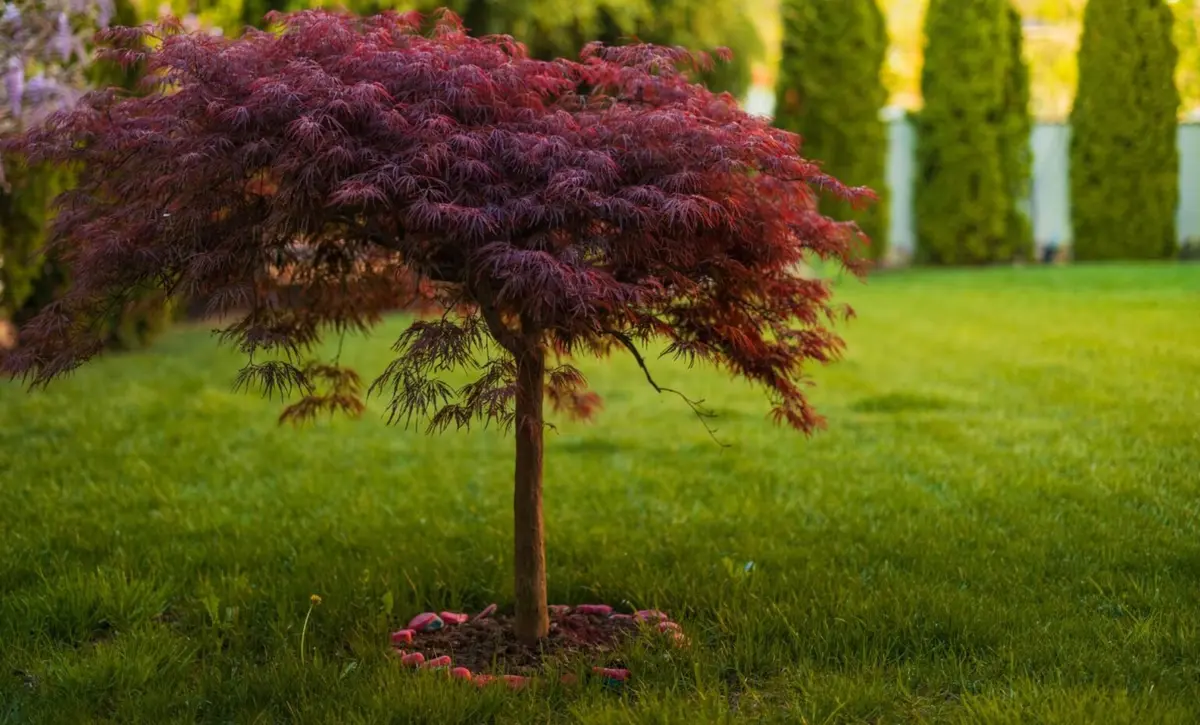
Japanese Maple 'Inaba-shidare'
Acer palmatum 'Inaba-shidare'
A vigorous laceleaf Japanese maple whose deeply dissected leaves emerge deep purple, hold purple-red through summer, and blaze bright red in fall over a graceful cascading mound.
Keep reading Show less
Acer palmatum ‘Inaba-shidare’ is a laceleaf (dissectum) Japanese maple prized for combining vigor with grace. Where many cutleaf maples stay small and shrubby, ‘Inaba-shidare’ grows more strongly upright before its branches arch over into a broad, cascading mound — reaching 4–6 feet in its first ten years and eventually 10 feet tall and 12 feet or more across. It is native (as a species) to Japan, Korea, and China, and has been cultivated as a garden treasure for the better part of a century.
Foliage that holds its color
The cultivar’s signature is its deeply dissected, seven-lobed leaves, cut almost to the base into a feathery, thread-like texture. New foliage emerges deep purple in spring, matures to a rich purple-red through summer — resisting the fade to green that afflicts many red laceleaf maples in the heat — and finally ignites to a brilliant red in autumn. Small reddish flowers appear in spring, followed by paired winged samaras, but the plant is grown overwhelmingly for its leaves and its silhouette.
A specimen for the discerning garden
Its cascading, mushroom-like form makes ‘Inaba-shidare’ a natural focal point: set it as a specimen near a patio, at the edge of a border, in a rock garden, or beside a pond where the weeping branches can be reflected in the water. It is also an excellent sun-dappled understory plant beneath taller trees, and smaller plants do well in containers. Deer generally leave it alone. The cultivar has earned the RHS Award of Garden Merit for its reliable garden performance.
Care tips
Plant in moist, organically rich, slightly acidic, well-drained soil, and mulch generously to keep the shallow roots cool and evenly moist. Full sun brings out the strongest color in cooler climates, but in hot-summer regions give it afternoon shade and shelter from drying winds to prevent leaf scorch. Keep pruning to a minimum; if you must prune, do it from late fall to mid-winter while the tree is dormant — pruning in spring or summer causes significant sap bleeding. Watch for aphids, scale, and mites, and avoid high-pH soils, which can cause chlorosis.
Fun Fact
'Inaba-shidare' means 'leaf of Inaba' — Inaba being an old province of Japan — paired with shidare, 'cascading' or 'weeping.' Introduced before 1930, it has proven so reliable that it holds the Royal Horticultural Society's Award of Garden Merit, and unlike many red laceleaf maples it keeps its purple-red color through summer heat rather than fading to green.
Habitat & form
Where it's from and what to expect.
- Native range
- Japan, Korea, and China
- Plant type
- Tree
- Mature size
- 4–6 ft tall in its first decade, eventually to about 10 ft tall and 12 ft or more wide; slow-growing, upright yet cascading mound.
- Bloom
- Small reddish-purple flowers in spring, attractive up close but not showy, followed by paired winged samaras. Grown chiefly for its foliage and form.
- Hardiness
- USDA zones 5–8.
Care
How to keep it happy.
- Sunlight
- Full sun to part shade. Full sun is fine in the north, but afternoon shade is best in hot-summer regions to prevent leaf scorch. Shelter from strong winds.
- Water
- Regular; keep soil consistently moist but never waterlogged. Avoid hot, dry sites and drought stress, which scorch the delicate foliage.
- Soil
- Moist, organically rich, slightly acidic, well-drained loam; tolerates sandy loams. Mulch to retain moisture and keep the shallow roots cool. Chlorosis can occur in high-pH soils.
- Planting distance
- 10–12 ft apart as a specimen, based on mature spread.
- Propagation
- Not applicable
- Pruning
- Keep pruning minimal. If needed, prune from late fall to mid-winter while dormant — spring or summer cuts cause heavy bleeding.
- Pet safety
- Non-toxic