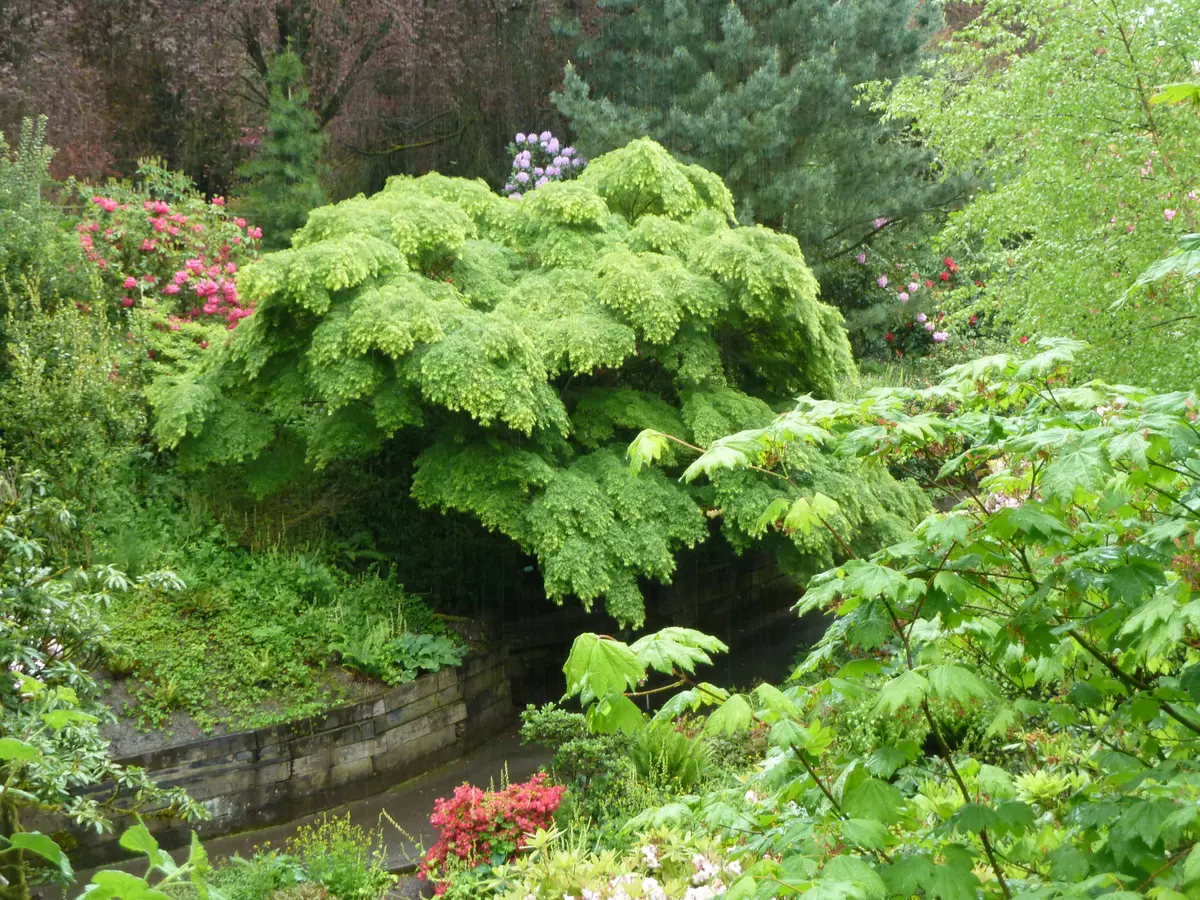
Japanese Maple 'Seiryu'
Acer palmatum 'Seiryu'
An upright laceleaf Japanese maple with finely divided green foliage and yellow, orange, and red autumn color.
Keep reading Show less
‘Seiryu’ brings fine texture to a woodland edge or specimen planting without the low, cascading framework of most laceleaf Japanese maples. Its green summer canopy develops warm autumn color before revealing the branching structure.
Give the roots space away from thirsty competitors, and choose a sheltered position rather than a hot, exposed corner. Let the natural canopy develop instead of shearing it into a compact shape.
Care sources: NC State Extension: ‘Seiryu’, RHS: growing Japanese maples, Missouri Botanical Garden: Japanese-maple culture and April flowering.
Photo: Wendy Cutler on Flickr, CC BY 2.0; resized and cropped for display.
Fun Fact
Unlike the familiar weeping laceleaf maples, 'Seiryu' builds an upright, vase-shaped framework.
Habitat & form
Where it's from and what to expect.
- Native range
- Japan and Korea (species); cultivated selection
- Plant type
- Tree · Perennial
- Mature size
- About 10–15 ft tall and 8–12 ft wide, with an upright, vase-shaped framework and a spreading canopy.
- Bloom
- Small, inconspicuous reddish flowers in April, followed by paired winged seeds; grown mainly for foliage and form.
- Hardiness
- USDA zones 5–8. Protect newly emerging leaves from late spring frosts.
Care
How to keep it happy.
- Sunlight
- Full sun to part shade; afternoon shade and shelter from drying winds help protect the finely cut leaves from scorch.
- Water
- Keep the root zone evenly moist but not waterlogged. Water deeply during dry spells, especially while establishing and in containers.
- Soil
- Humus-rich, well-drained soil, preferably slightly acidic; tolerates neutral soil. Avoid compacted, persistently wet ground.
- Fertilizer
- No routine fertilizer for healthy, established plants.
- Planting distance
- Allow 8–12 ft between tree centers and about 6 ft from a wall or path edge for the mature canopy.
- Propagation
- Preserve the cultivar by layering in autumn or early spring, or by specialist grafting. Seedlings do not come true to name.
- Pruning
- Prune sparingly in late fall to midwinter, after leaf fall. Remove dead, crossing, or badly placed branches; avoid spring pruning when sap is rising.
- Pet safety
- Unknown
Discourage chewing; ask a veterinarian about ingestion.