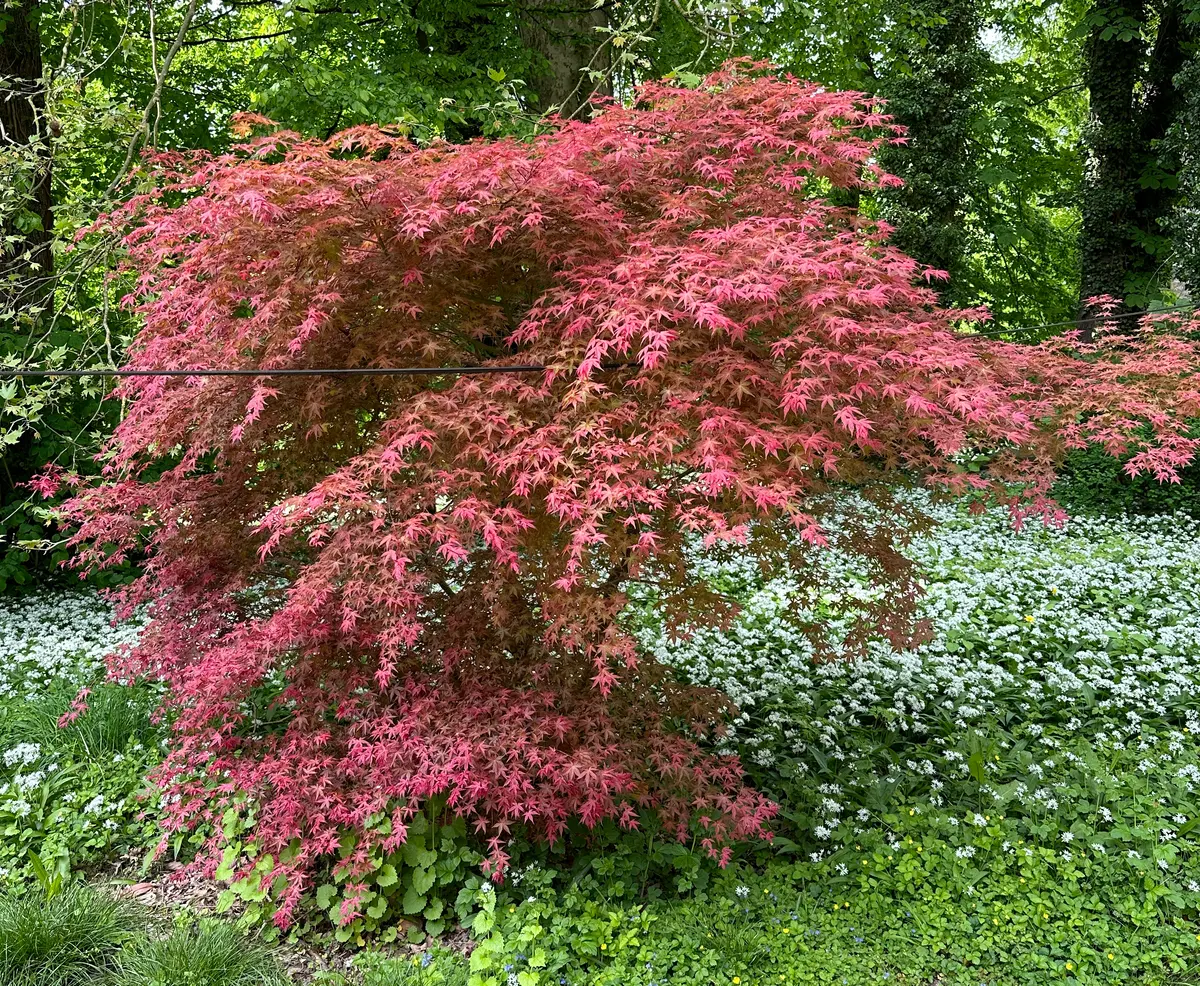
Japanese Maple 'Shindeshojo'
Acer palmatum 'Shindeshojo'
A compact, rounded Japanese maple with brilliant crimson spring leaves that mature green before turning red and orange in autumn.
Keep reading Show less
‘Shindeshojo’ is a small, shrubby maple rather than a large shade tree. Its strongest red display comes with the new spring leaves, so summer-green foliage is normal rather than a sign that the cultivar has been lost.
Use it as a specimen near a woodland edge or in a sheltered mixed border. Give it room to spread naturally and avoid hot, dry sites.
Care sources: Missouri Botanical Garden: ‘Shindeshojo’, RHS: growing and propagating Japanese maples.
Photo: Michael Wolf on Wikimedia Commons, CC BY-SA 3.0; resized and cropped for display.

Fun Fact
The bright spring-red leaves can hold their color for a month before gradually becoming green for summer.
Habitat & form
Where it's from and what to expect.
- Native range
- Japan and Korea (species); cultivated selection
- Plant type
- Shrub · Perennial
- Mature size
- Typically 5–7 ft tall and wide, eventually reaching 7–10 ft; slow-growing with an upright, rounded, shrubby habit.
- Bloom
- Small red flowers in April are inconspicuous beside the crimson spring foliage.
- Hardiness
- USDA zones 5–9. Emerging leaves can be damaged by late spring frost.
Care
How to keep it happy.
- Sunlight
- Full sun to part shade, with afternoon shade in hot areas. Shelter from strong winds to reduce leaf scorch.
- Water
- Keep the soil consistently moist but freely drained. Water deeply in dry spells, particularly during establishment and while the spring leaves are expanding.
- Soil
- Moist, organically rich, slightly acidic, well-drained soil; sandy loam is suitable. Avoid poorly drained ground and strongly alkaline soil.
- Fertilizer
- No routine fertilizer for healthy, established plants.
- Planting distance
- Allow 7–10 ft between shrub centers and about 5 ft from walls or paths for the eventual spread.
- Propagation
- Layer in autumn or early spring, or use specialist grafting to preserve the cultivar. Seedlings do not come true.
- Pruning
- Prune only as needed in late fall to midwinter, after leaf fall. Remove dead or crossing branches without shearing the natural rounded outline; avoid spring pruning.
- Pet safety
- Unknown
Discourage chewing; ask a veterinarian about ingestion.