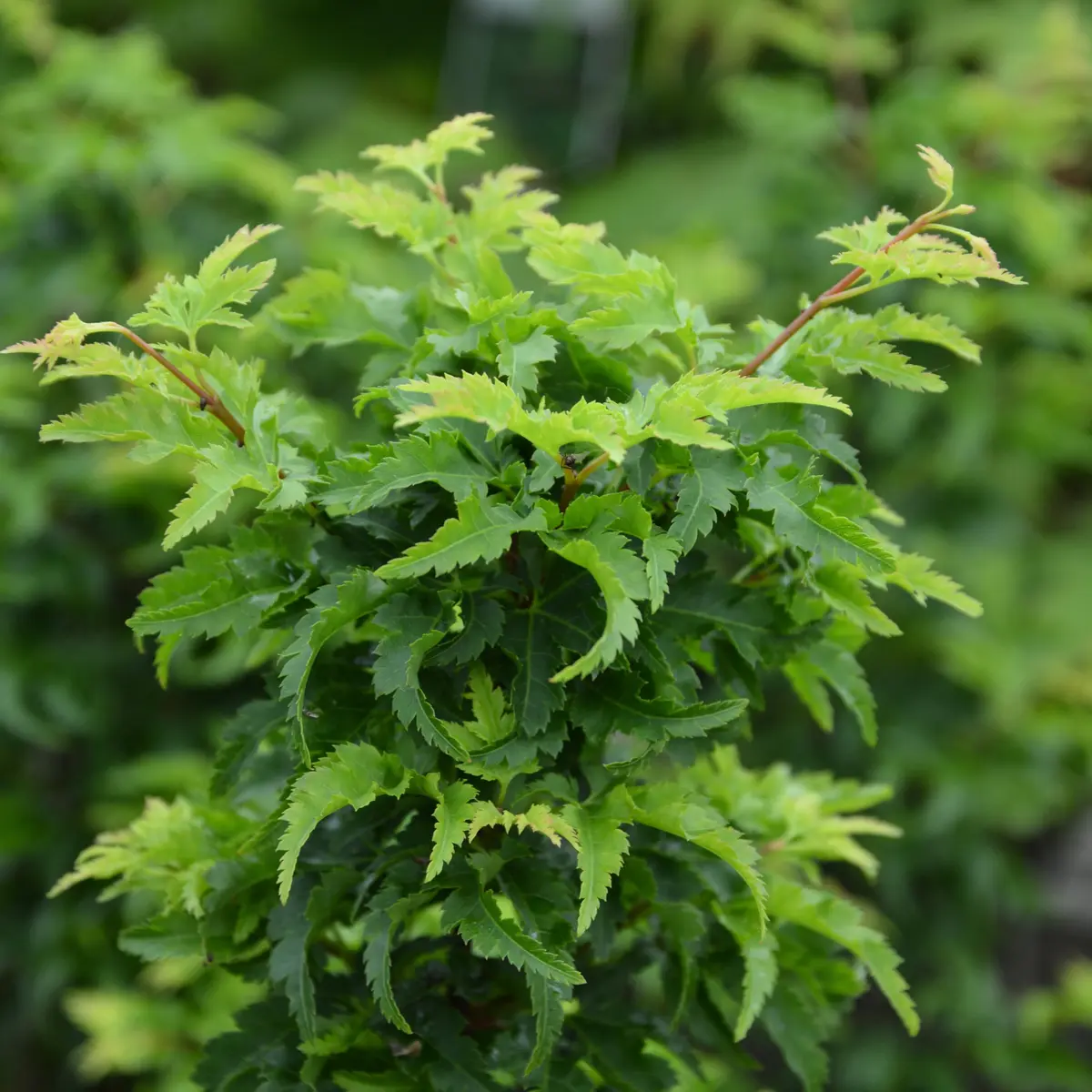
Japanese Maple 'Shishigashira'
Acer palmatum 'Shishigashira'
A slow-growing, upright Japanese maple with dense tufts of crinkled green leaves that turn gold and crimson in autumn.
Keep reading Show less
‘Shishigashira’, also called lion’s-head maple, brings a dense, sculptural texture to a sheltered border or woodland edge. The curled leaves are a normal cultivar trait, not a reason to prune off healthy shoots.
Young trees can look sparsely furnished before the crown fills out. Give this slow grower room for its eventual width rather than treating it as a permanently miniature tree.
Care sources: Missouri Botanical Garden: ‘Shishigashira’, RHS: growing and propagating Japanese maples.
Photo: Pépinière.ca.
Fun Fact
Shishigashira means lion's head, a reference to the mane-like clusters of curled leaves.
Habitat & form
Where it's from and what to expect.
- Native range
- Japan, Korea and China (species); cultivated selection
- Plant type
- Tree · Perennial
- Mature size
- Slowly reaches 7–15 ft tall and 5–12 ft wide, with a compact, upright crown that broadens with age.
- Bloom
- Small reddish-purple flowers appear in April; they are inconspicuous among the developing leaves.
- Hardiness
- USDA zones 5–8. Protect emerging leaves from late spring frosts.
Care
How to keep it happy.
- Sunlight
- Full sun to part shade, with afternoon shade in hot areas. Shelter from drying winds and reflected heat to limit leaf scorch.
- Water
- Keep soil evenly moist but never waterlogged. Water deeply during dry spells, especially while the tree is establishing, and check moisture beneath the surface before watering again.
- Soil
- Moist, organically rich, slightly acidic to neutral, well-drained soil. Sandy loam is suitable; avoid poorly drained ground and strongly alkaline soil.
- Fertilizer
- No routine fertilizer for healthy, established plants.
- Planting distance
- Allow 10–12 ft between tree centers for separate mature crowns, and about 6 ft from walls or paths to accommodate the eventual spread.
- Propagation
- Layer in autumn or early spring to preserve the cultivar, or use specialist grafting. Seedlings do not come true.
- Pruning
- Prune only as needed in late fall to midwinter, after leaf fall. Remove dead, crossing or badly placed branches without shearing the natural outline; avoid spring pruning when cuts can bleed sap.
- Pet safety
- Unknown
Discourage chewing; ask a veterinarian about ingestion.