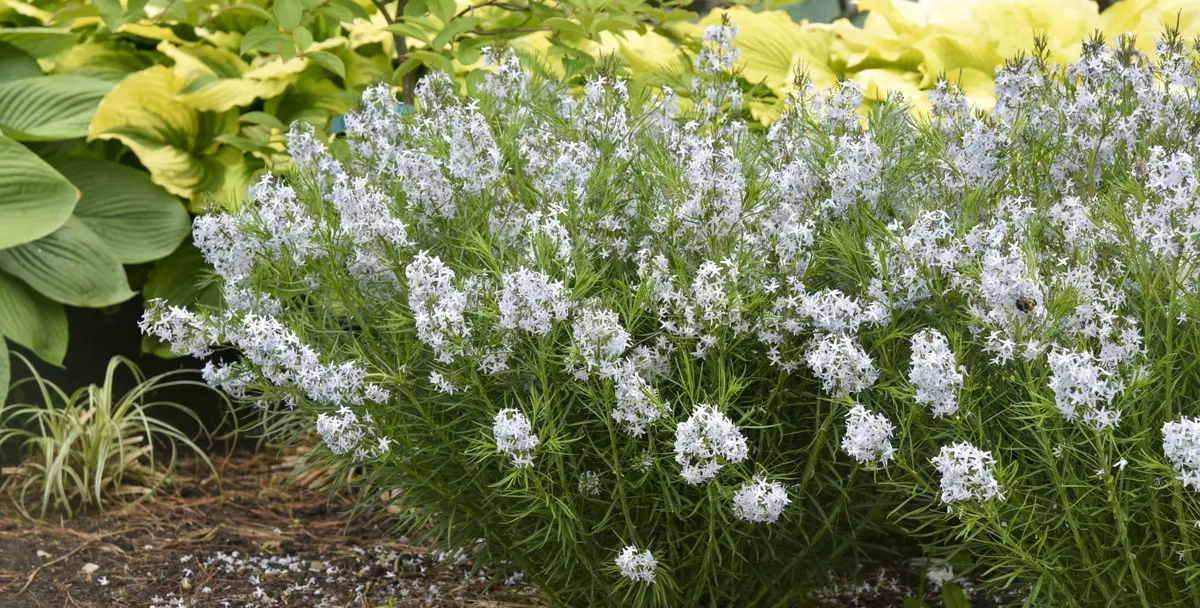
Blue Star Amsonia 'String Theory'
Amsonia hybrid 'String Theory'
A compact bluestar with airy threadleaf foliage, soft periwinkle-blue flowers in late spring, and glowing gold fall color.
Keep reading Show less
Amsonia ‘String Theory’ is a compact bluestar introduced by Proven Winners for gardeners who love the feathery look of Arkansas bluestar but need a shorter, tidier plant. The breeder markets it as an amsonia hybrid, while reference sites often describe it as very closely allied to Amsonia hubrichtii; either way, its threadlike foliage, cool blue flowers, and golden fall color all read unmistakably as threadleaf bluestar.
In late spring, rounded clusters of pale periwinkle-blue flowers float above a fine-textured mound that stays attractive long after bloom. Through summer the foliage brings a soft, almost grassy texture to the border, and by autumn it shifts to bright gold. Butterflies and other pollinators visit the flowers, while deer usually leave the plant alone.
Give it a sunny to lightly shaded spot with decent drainage and avoid pushing it with overly rich soil, which can make the stems open up. Once established it handles normal dry spells well, though it looks fullest with average moisture. If the clump loosens after bloom, trim it lightly to neaten the mound; otherwise leave it alone until late winter. Like other amsonias, broken stems bleed a milky sap, so gloves are a good idea when cutting it back.
Fun Fact
Amsonia is named for Dr. John Amson, an 18th-century Williamsburg physician and amateur botanist; when cut, the stems ooze a milky latex that helps deter browsing.
Habitat & form
Where it's from and what to expect.
- Native range
- Cultivated selection of a south-central U.S. native bluestar (Arkansas and Oklahoma)
- Plant type
- Perennial
- Mature size
- About 18–30 in tall and 32–36 in wide.
- Bloom
- Soft periwinkle-blue, star-shaped flowers in late spring to early summer.
- Hardiness
- USDA zones 4–9.
Care
How to keep it happy.
- Sunlight
- Full sun to part sun. Best flowering and fall color come with plenty of sun.
- Water
- Average moisture while establishing; tolerates short dry spells once mature.
- Soil
- Average, well-drained soil; adaptable to clay and poorer ground as long as it does not stay soggy.
- Planting distance
- 32–36 in apart.
- Propagation
- Divide established clumps in spring or fall; named cultivars are best kept vegetative rather than grown from seed.
- Pruning
- Trim splaying stems by 6 in after flowering. Otherwise cut back in late winter. Wear gloves; milky sap can irritate skin.
- Pet safety
- Unknown
Prevent chewing.