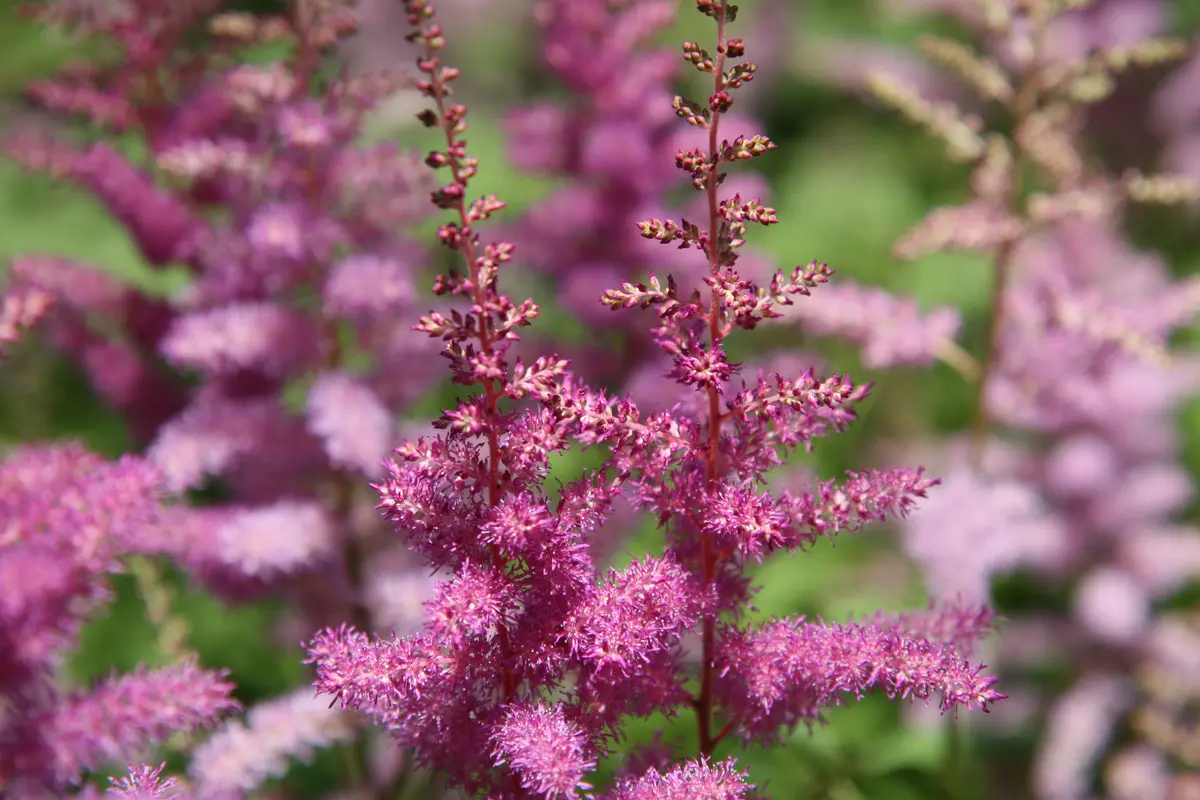
Astilbe 'Amethyst'
Astilbe × arendsii 'Amethyst'
A classic Arends hybrid astilbe with dense, upright lilac-purple plumes over deep green, fern-like foliage — a reliable shade perennial that needs steady moisture to thrive.
Keep reading Show less
Astilbe × arendsii ‘Amethyst’ brings dense, upright plumes of lilac-purple flowers over deep green, finely cut foliage — a dependable shade perennial as long as its one real requirement, steady moisture, is met.
An original Arends hybrid
‘Amethyst’ belongs to the Astilbe × arendsii group, bred in the early 1900s by German nurseryman Georg Arends by crossing several Asian astilbe species. That breeding program is responsible for the vast majority of astilbe cultivars grown today, and more than a century later, ‘Amethyst’ remains a garden staple.
Care tips
Site in part to full shade with rich, humus-enriched soil that stays evenly moist — astilbes decline quickly in dry soil, showing scorched, browning foliage. Mulching helps conserve moisture through summer heat. Leave the spent flower plumes standing for winter texture, or cut them back for tidiness, and divide congested clumps every three to four years in early spring to keep the planting vigorous.
Fun Fact
'Amethyst' is one of the original Astilbe × arendsii hybrids bred by German nurseryman Georg Arends in the early 1900s — a breeding program that produced most of the astilbe cultivars still grown in gardens today.
Habitat & form
Where it's from and what to expect.
- Native range
- Garden hybrid of species native to China, Japan, and Korea
- Plant type
- Perennial
- Mature size
- Grows 24–36 in. tall and 18–24 in. wide.
- Bloom
- Lilac-purple flower plumes in late spring to early summer.
- Hardiness
- USDA zones 4–8.
Care
How to keep it happy.
- Sunlight
- Part shade to full shade; tolerates more sun where soil stays consistently moist.
- Water
- Requires consistently moist soil; does not tolerate drought. Mulch to help retain moisture.
- Soil
- Rich, humusy, well-drained soil with good moisture retention; slightly acidic to neutral pH.
- Planting distance
- 18–24 in apart, based on mature spread.
- Propagation
- Divide in spring or fall
- Pruning
- Deadhead or leave spent plumes for winter interest; divide congested clumps every 3–4 years in early spring.
- Pet safety
- Non-toxic