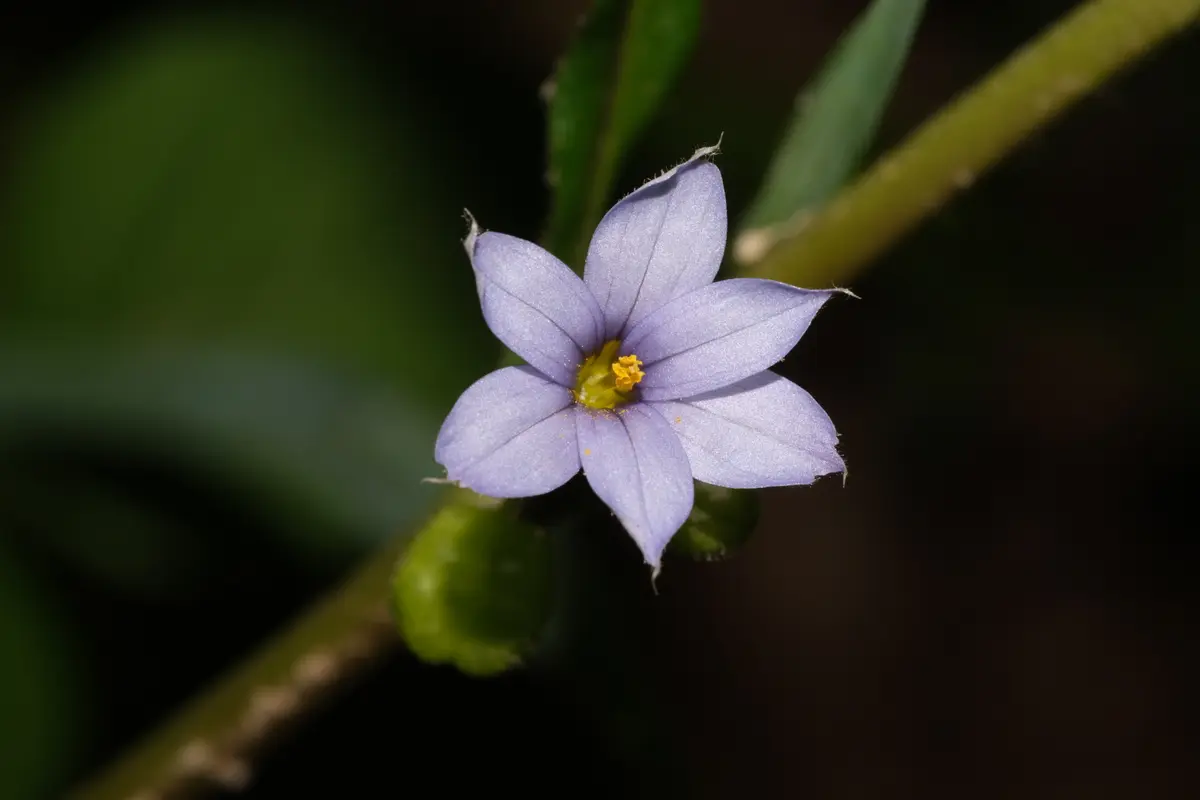
Blue-eyed Grass 'Lucerne'
Sisyrinchium angustifolium 'Lucerne'
A grass-like perennial in the iris family with star-shaped violet-blue flowers held above narrow, blue-green foliage in late spring.
Keep reading Show less
Sisyrinchium angustifolium ‘Lucerne’ is a compact, clump-forming perennial native to damp woods, meadows, and stream banks across eastern North America. Despite its narrow, grass-like foliage, it’s actually a member of the iris family (Iridaceae) — and each stem is topped in late spring with small, six-pointed, violet-blue flowers centered on a golden-yellow eye.
Bigger blooms, better behavior
‘Lucerne’ is prized for flowers noticeably larger than the wild species — up to an inch across — and for self-seeding less aggressively, making it a tidier choice for borders, rock gardens, and small-space plantings. Its clumping habit and neat foliage work well as an edging plant or massed in drifts, where the star-shaped flowers open in the morning sun.
Care tips
Plant in full sun to part shade in well-drained soil with average to consistent moisture; good drainage is important to prevent crown rot over winter. Shear the clump back after flowering to tidy its appearance and curb self-seeding, and divide every two to three years to keep plants vigorous. It’s low-maintenance and largely untroubled by pests or disease.
Fun Fact
Despite its grass-like leaves, blue-eyed grass isn't a grass at all — it's a member of the iris family. The 'Lucerne' cultivar wasn't bred; it was a chance discovery found growing near Lucerne, Switzerland, and later introduced by White Flower Farm.
Habitat & form
Where it's from and what to expect.
- Native range
- Eastern North America
- Plant type
- Perennial
- Mature size
- 8–12 in tall and 6–12 in wide.
- Bloom
- Violet-blue, star-shaped flowers with a golden-yellow eye, up to 1 in across — notably larger than the species — from late spring through early summer.
- Hardiness
- USDA zones 5–9 (some sources report hardiness to zone 3).
Care
How to keep it happy.
- Sunlight
- Full sun to part shade.
- Water
- Medium — moist to average soil preferred, though it tolerates some drought once established. Good drainage prevents winter crown rot.
- Soil
- Well-drained, humus-rich soil; adaptable to sandy, loamy, or clay soils and a range of pH.
- Planting distance
- 6–12 in apart.
- Propagation
- Divide every 2–3 years to maintain vigor. Self-seeds, though 'Lucerne' does so less readily than the straight species.
- Pruning
- Shear back after flowering to remove spent stalks, tidy the clump, and limit self-seeding.
- Pet safety
- Non-toxic