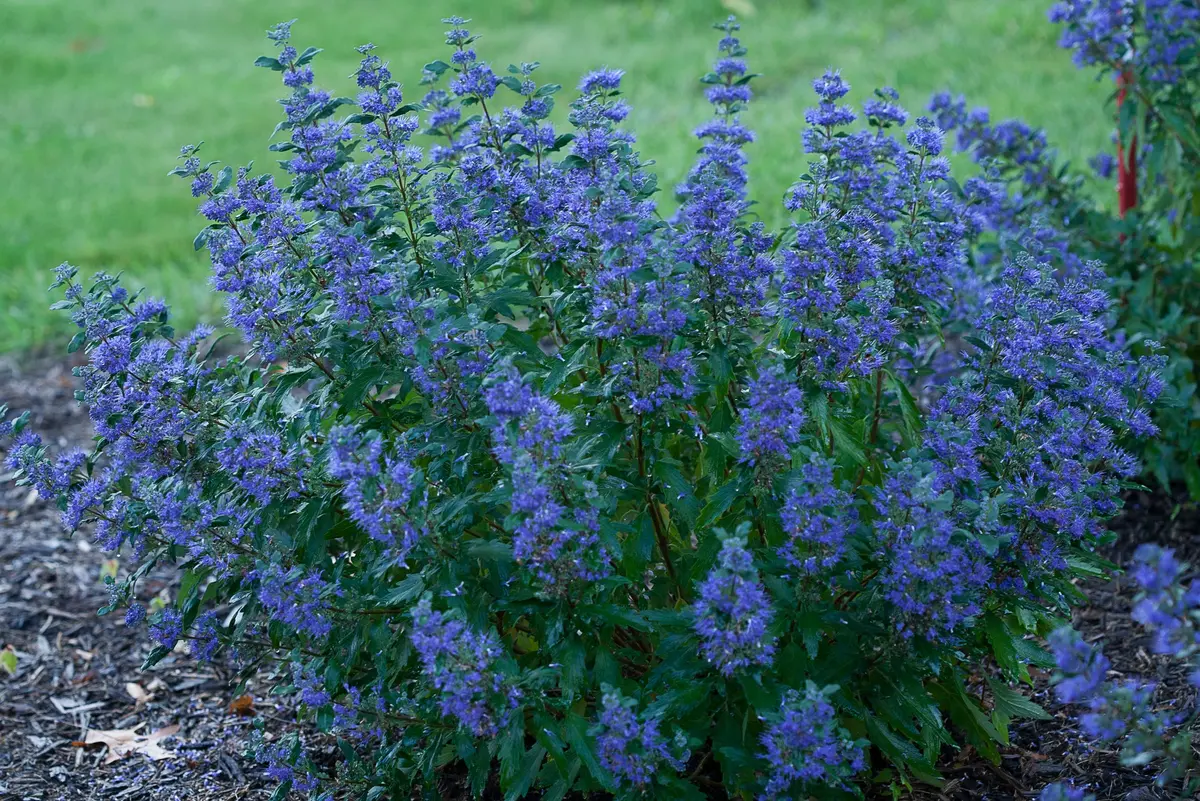
Bluebeard 'Beyond Midnight'
Caryopteris × clandonensis 'Beyond Midnight®'
A compact, mounding shrub with dark glossy foliage and masses of deep blue flowers in late summer and fall, loved by bees and butterflies.
Keep reading Show less
Caryopteris × clandonensis Beyond Midnight® is a compact, mounding bluebeard with glossy dark green leaves and spikes of deep blue flowers that arrive in late summer and last into fall. It fills a gap when much of the garden is fading and is a reliable magnet for bees and butterflies.
An easy sun-lover
Give it full sun and loose, well-drained soil. Once established it is drought tolerant, pest and disease resistant, and rarely bothered by deer. The foliage is aromatic when brushed. Use it in groups, in borders, or as a low informal hedge.
Care tips
Flowers form on new wood, so cut back in late winter or early spring, just above emerging growth. Stems may die back over winter in colder zones. Avoid wet soil and heavy fertilizer.
Propagation reference: RHS.
Fun Fact
Bluebeard is also called blue mist or blue spirea. Because it flowers on new growth in late summer and fall, a hard spring cutback actually improves the show.
Habitat & form
Where it's from and what to expect.
- Native range
- Garden hybrid (Caryopteris incana × C. mongholica); parent species native to East Asia
- Plant type
- Shrub · Perennial
- Mature size
- About 2–3 ft tall and wide; compact and mounded.
- Bloom
- Deep blue flower spikes on new wood from late summer into fall, when little else is blooming.
- Hardiness
- USDA zones 5–9; stems may die back to the ground in cold winters but regrow from the base.
Care
How to keep it happy.
- Sunlight
- Full sun (6+ hours).
- Water
- Low to moderate; drought tolerant once established. Avoid wet soil, which can cause crown rot.
- Soil
- Loose, well-drained average soil. Avoid heavy fertilizer, which makes growth lanky.
- Fertilizer
- No routine fertilizer for healthy, established plants.
- Planting distance
- 24–36 in apart.
- Propagation
- Take softwood cuttings in late spring or semi-ripe cuttings in summer.
- Pruning
- Cut back hard in late winter to early spring, just above where new growth appears; it blooms on new wood.
- Pet safety
- Unknown
Prevent chewing.