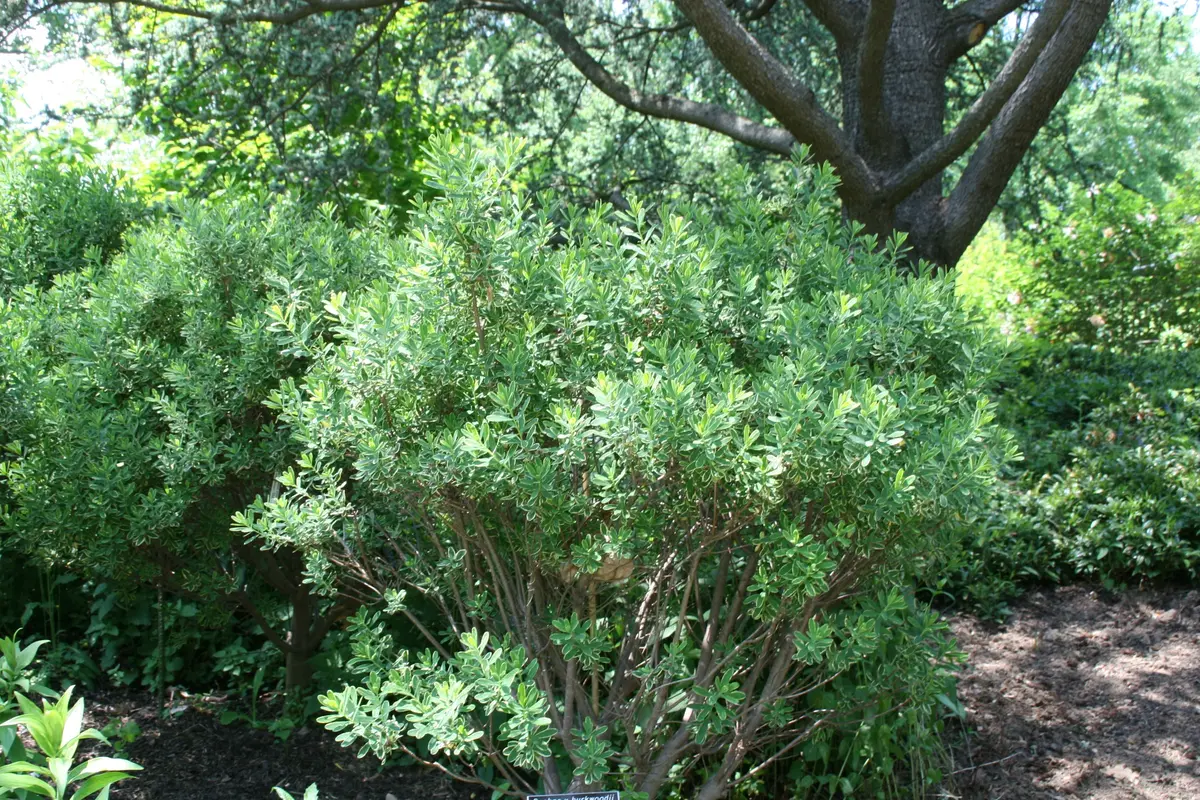
Daphne 'Carol Mackie'
Daphne × burkwoodii 'Carol Mackie'
A compact, semi-evergreen shrub with gold-edged leaves and clusters of intensely fragrant pale pink flowers in mid-spring.
Keep reading Show less
Daphne × burkwoodii ‘Carol Mackie’ is a compact, rounded, semi-evergreen shrub with small leaves edged in cream-gold. In mid-spring it is covered with clusters of very fragrant pale pink flowers that can be smelled from several feet away, and it may bloom lightly again in fall.
Placement matters
Daphnes can be finicky. They want moist but very well-drained soil, light shade, and shelter from cold winds. They resent being moved, so choose the spot carefully, ideally beside a path, entry or seating area where the scent can be enjoyed. At 3–4 feet it suits foundation plantings, borders, slopes and small spaces.
Care tips
Mulch to keep roots cool, water only when needed, and skip heavy fertilizer. Prune only to remove dead branches. The plant can be short-lived and sometimes fails without obvious cause. The red berries and other parts are poisonous, so keep pets and children away.
Fun Fact
'Carol Mackie' began as a chance variegated branch, or sport, discovered in a garden in 1962.
Habitat & form
Where it's from and what to expect.
- Native range
- Garden hybrid (Daphne caucasica × D. cneorum), bred in England
- Plant type
- Shrub · Perennial
- Mature size
- 3–4 ft tall and wide; slow-growing, dense and rounded.
- Bloom
- Very fragrant, pale pink flower clusters in mid-spring, with a light repeat bloom in fall. Followed by poisonous red berries.
- Hardiness
- USDA zones 4–7.
Care
How to keep it happy.
- Sunlight
- Light to part shade; protect from hot afternoon sun and cold winter winds.
- Water
- Moderate; keep soil evenly moist but never soggy.
- Soil
- Moist, very well-drained, humusy soil. Mulch to keep roots cool. Poor drainage is a common cause of sudden death.
- Fertilizer
- No routine fertilizer for healthy, established plants.
- Planting distance
- 3–4 ft apart.
- Propagation
- Take semi-hardwood cuttings in summer or graft in winter.
- Pruning
- Do not prune except to remove dead branches; it recovers poorly from hard pruning.
- Pet safety
- Highly toxic
Keep pets away from berries and bark.