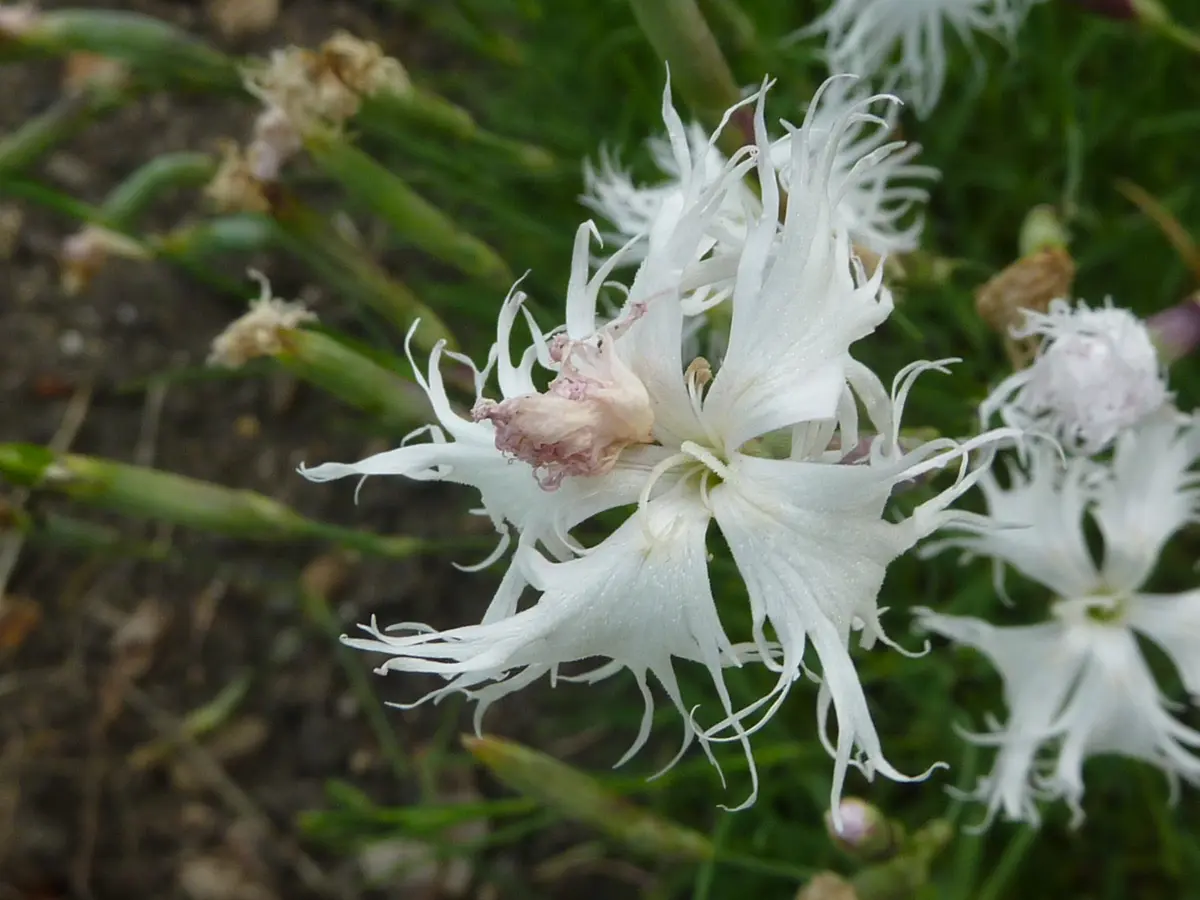
Dianthus
Dianthus
A classic cottage-garden mainstay — low cushions of slender blue-green foliage topped by fringed, clove-scented flowers in pink, white and red from late spring into summer.
Keep reading Show less
Dianthus is a large genus in the carnation family (Caryophyllaceae) with more than 27,000 registered cultivar names, grown as annuals, biennials and — most usefully in the garden — evergreen perennials. The group includes cottage pinks, cheddar pinks, sweet William and the florist’s carnation. Most form neat cushions or mats of narrow, often glaucous blue-green leaves that look good even out of flower.
Fringed, clove-scented flowers
The flowers are the draw: five petals with the characteristic fringed or “pinked” margin, frequently with a contrasting eye, carried above the foliage from late spring into summer. Many are powerfully clove-scented. They are excellent small cut flowers and a magnet for bees and butterflies.
Care tips
Pinks are sun-lovers that demand sharp drainage and good airflow — the quickest way to lose one is heavy, wet soil over winter. Give them lean, neutral-to-alkaline ground, shear lightly after flowering to tidy the mound and coax a rebloom, and divide congested clumps every few years. They are happily ignored by deer. Note that while the petals are edible when grown without pesticides, the foliage is mildly toxic and can irritate sensitive skin.
Fun Fact
The common name 'pinks' has nothing to do with the colour. It refers to the petals' frilly, pinked edges — as if trimmed with pinking shears. The verb came first; the colour pink was later named after the flower, not the other way around.
Habitat & form
Where it's from and what to expect.
- Native range
- Europe and Asia (a few from southern Africa)
- Plant type
- Perennial
- Mature size
- Most garden pinks form low mounds 6–15 in. tall and about 12 in. wide; border carnations can reach 2–3 ft.
- Bloom
- Fragrant, fringed five-petalled flowers in pink, white, red and bicolors, late spring into summer. Deadheading prolongs the display.
- Hardiness
- USDA zones 4–9 (varies by species).
Care
How to keep it happy.
- Sunlight
- Full sun, with a little afternoon shade tolerated in hot climates.
- Water
- Low to moderate. Water during dry spells while establishing; mature plants are drought tolerant and resent wet feet.
- Soil
- Well-drained, neutral to slightly alkaline soil with good air circulation. Tolerates lean, gritty or sandy ground; soggy soil causes crown and root rot.
- Planting distance
- 10–12 in apart for mounding garden pinks; up to 18 in for taller border carnations.
- Propagation
- Softwood cuttings in spring
- Pruning
- Low maintenance. Shear the mound lightly after the main flush to keep it tidy and encourage a second round of bloom.
- Pet safety
- Mildly toxic
Above-ground parts (flowers, leaves, stems) cause mild upset