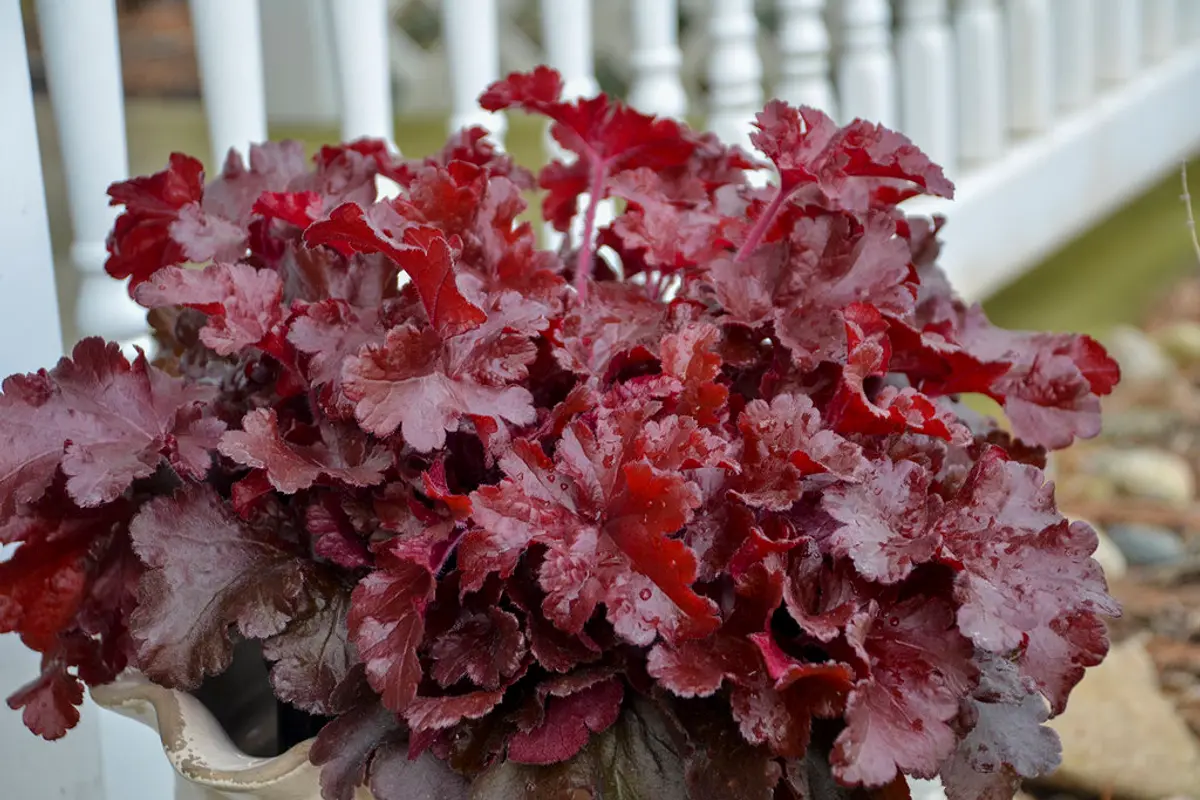
Coral Bells 'Cherry Truffles'
Heuchera Dolce® 'Cherry Truffles'
Archived — no longer in the garden Did not survive initial planting (Summer 2026).
A compact coral bells with heavily ruffled leaves that open bright cherry red and mature to rich mahogany, topped with airy light-pink flowers — happy in sun or shade.
Keep reading Show less
Heuchera Dolce® ‘Cherry Truffles’ is a coral bells grown above all for its foliage: a low, tidy mound of large, heavily ruffled leaves that emerge a vivid cherry red in spring and deepen to a rich mahogany red as the season goes on. Because older leaves darken while new ones keep coming in bright, the plant reads as a shifting blend of red tones from spring through fall.
Unusually adaptable, it holds up in everything from full sun to full shade, keeping its best color where it gets a little light. In midsummer it sends up airy sprays of small light-pink flowers on slender stems that hover over the foliage and pull in bees, butterflies, and hummingbirds. Give it humus-rich, well-drained soil, tidy the foliage in early spring, and it will return reliably year after year — in a border, a container, or massed along a shaded path.
Fun Fact
The 'Dolce' in the series name is Italian for 'sweet' — fitting for a lineup of coral bells named after desserts. 'Cherry Truffles' gets its ever-shifting color from anthocyanin pigments that deepen as the leaves age, so a single plant carries bright cherry-red new growth and dark mahogany older leaves at the same time.
Habitat & form
Where it's from and what to expect.
- Native range
- Garden hybrid (the genus is native to North America)
- Plant type
- Perennial
- Mature size
- 8–10 in. tall in leaf, 26–30 in. wide; flower scapes reach 18–22 in.
- Bloom
- Slender wands of small light-pink flowers rise above the foliage in midsummer, drawing bees, butterflies, and hummingbirds.
- Hardiness
- USDA zones 4–9.
Care
How to keep it happy.
- Sunlight
- Adaptable — thrives in part shade but grows in full sun to full shade. Best leaf color holds with some sun; shelter from hot afternoon sun in the warmest zones.
- Water
- Average; water when the top inch or two of soil dries. Needs good drainage and dislikes sitting wet, especially over winter.
- Soil
- Humus-rich, well-drained soil of average fertility amended with organic matter (leaf compost or pine-bark fines); slightly acidic to neutral pH. Dislikes heavy clay. Salt tolerant.
- Planting distance
- 24–30 in apart, based on mature spread.
- Propagation
- Divide in spring
- Pruning
- Maintenance: easy. Trim tattered or winter-burned leaves in early spring as fresh growth begins; remove spent flower scapes. Divide every few years to keep it vigorous.
- Pet safety
- Non-toxic