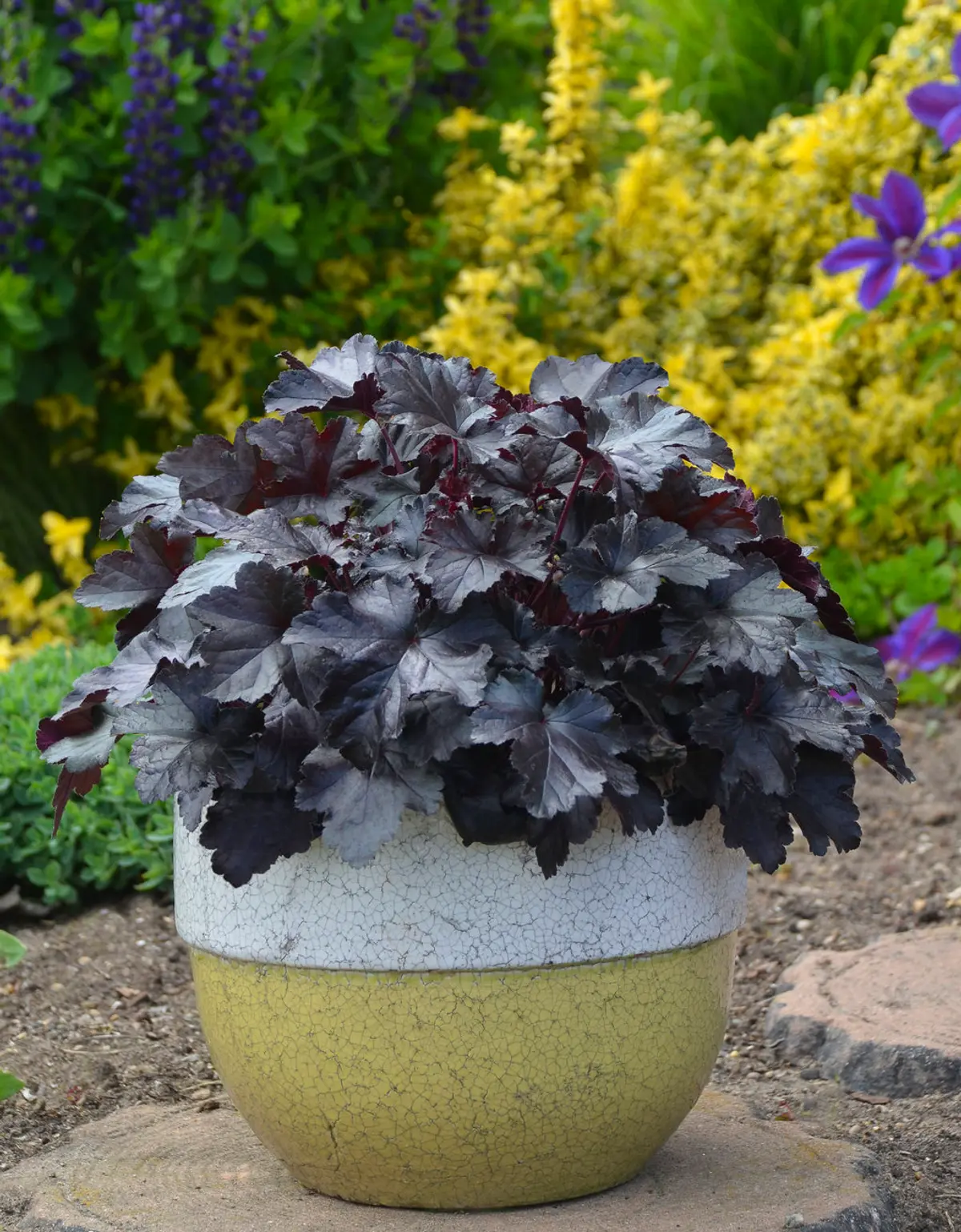
Coral Bells 'Black Pearl'
Heuchera Primo® 'Black Pearl'
An award-winning coral bells with a dense mound of glossy, ruffled jet-black leaves and airy sprays of white flowers — happy in sun or shade and a 2018 Perennial of the Year.
Keep reading Show less
Heuchera Primo® ‘Black Pearl’ is a coral bells grown above all for its foliage: a dense, weather-resistant mound of large, glossy leaves with scalloped, ruffled edges. The tops are a near-true jet black, while the undersides flush rosy purple — a combination that reads as inky and dramatic in the border, in a container, or massed along a shaded path.
Unusually adaptable for a dark-leaved heuchera, it holds up in everything from full sun to full shade, keeping its color best where it gets a little light. In midsummer it sends up airy sprays of small white flowers on slender stems that hover over the foliage and pull in bees, butterflies, and hummingbirds. Give it humus-rich, well-drained soil, tidy the foliage in early spring, and it will return reliably year after year.
Fun Fact
Named the 2018 Perennial of the Year by the National Garden Bureau. Its leaves are among the closest to true black in any hardy perennial — a color that comes from dense anthocyanin pigments, the same compounds that make blueberries and red cabbage their deep hues.
Habitat & form
Where it's from and what to expect.
- Native range
- Garden hybrid (the genus is native to North America)
- Plant type
- Perennial
- Mature size
- 8–10 in. tall in leaf, 18–20 in. wide; flower scapes reach 18–20 in.
- Bloom
- Slender wands of small white flowers with pink calyxes rise above the foliage in midsummer, drawing bees, butterflies, and hummingbirds.
- Hardiness
- USDA zones 4–9.
Care
How to keep it happy.
- Sunlight
- Adaptable — thrives in part shade but grows in full sun to full shade. The darkest leaf color holds best with some sun.
- Water
- Average; water when the top inch or two of soil dries. Needs good drainage and dislikes sitting wet, especially over winter.
- Soil
- Humus-rich, well-drained soil of average fertility amended with organic matter (leaf compost or pine-bark fines); slightly acidic to neutral pH. Dislikes heavy clay. Salt tolerant.
- Planting distance
- 18–20 in apart, based on mature spread.
- Propagation
- Divide in spring
- Pruning
- Maintenance: easy. Trim away tattered or winter-burned leaves in early spring as fresh growth begins; remove spent flower scapes to tidy the clump. Divide every few years to keep it vigorous.
- Pet safety
- Non-toxic