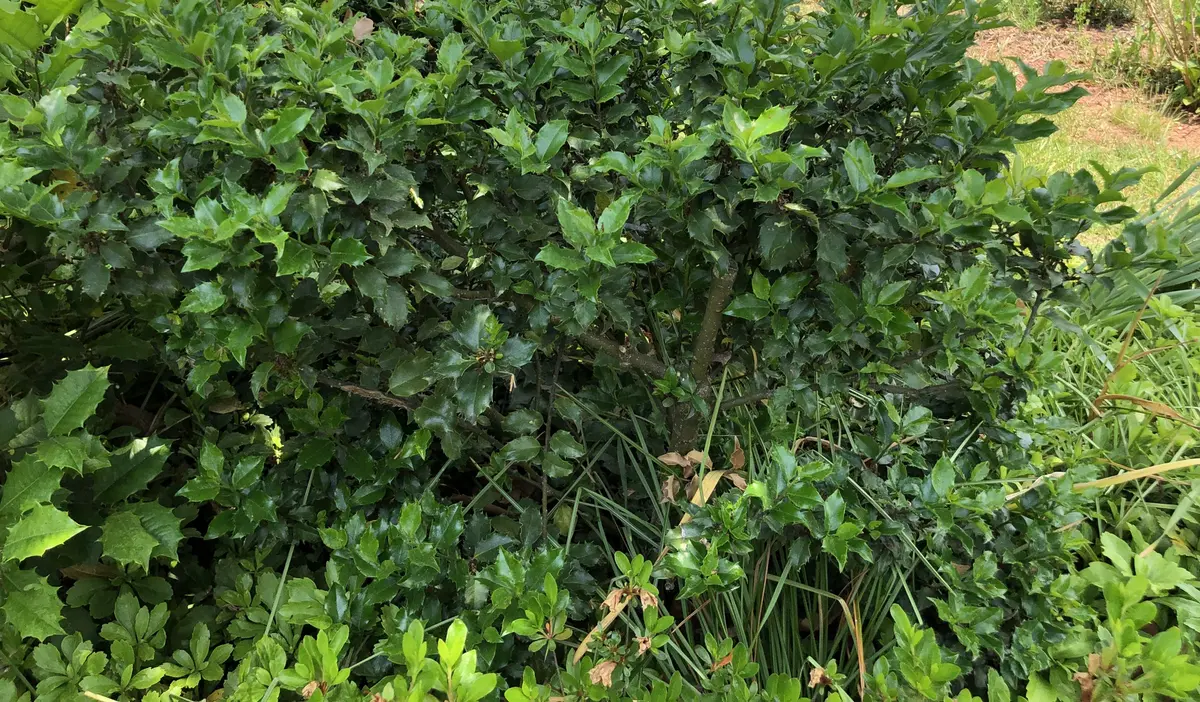
Blue Holly 'Blue Princess'
Ilex × meserveae 'Blue Princess'
A cold-hardy evergreen holly with spiny blue-green leaves and red winter berries when a male pollinator grows nearby.
Keep reading Show less
Ilex × meserveae ‘Blue Princess’ is a dense, rounded evergreen holly with glossy, spiny, blue-green leaves on purplish stems. It is one of the hardy “blue hollies” bred by Kathleen Meserve, and it keeps its good looks all winter when most of the garden has gone dormant.
Berries need a partner
Hollies are dioecious, and ‘Blue Princess’ is a female clone. Its small greenish-white spring flowers are easy to miss, but once pollinated they ripen into abundant bright red berries that often last into spring. Plant one male such as ‘Blue Prince’ for every three to five females, within the neighborhood of the female plants. Without a male the shrub is still handsome, just berry-free.
Uses
Use it as a screen, hedge, foundation planting or evergreen backdrop. The spiny leaves also give birds sheltered cover, and the berries feed them.
Care tips
Give it average, slightly acidic, moist, well-drained soil with some afternoon shade in hot summers and shelter from cold, drying winter winds. Watch for holly leafminer, spider mites, scale and leaf spots. The berries and leaves are mildly toxic to pets, so site it with that in mind.
Fun Fact
'Blue Princess' needs a male holly such as 'Blue Prince' nearby to produce berries.
Habitat & form
Where it's from and what to expect.
- Native range
- Garden hybrid (English holly × Tsuru holly), bred in New York, USA
- Plant type
- Shrub · Perennial
- Mature size
- 8–12 ft tall and 6–8 ft wide; slow-growing.
- Bloom
- Tiny, inconspicuous greenish-white flowers in May. Female plants set abundant dark red berries that persist through winter if pollinated.
- Hardiness
- USDA zones 5–8; in zone 5 site in a sheltered spot with winter protection.
Care
How to keep it happy.
- Sunlight
- Full sun to part shade; give afternoon shade in hot-summer areas and shelter from cold winter winds.
- Water
- Regular; keep evenly moist while establishing. Mulch to hold moisture and avoid drought stress.
- Soil
- Average, slightly acidic, moist, well-drained soil. High-pH soil can cause leaf yellowing (chlorosis).
- Fertilizer
-
Use Espoma Holly-tone only when soil is nutrient-deficient.
Late winter to early spring
- Planting distance
- 5–6 ft apart for a hedge; 6–8 ft as a specimen.
- Propagation
- Take semi-ripe cuttings in late summer or hardwood cuttings in autumn to midwinter.
- Pruning
- Prune lightly in winter to shape or shear as a hedge; remove dead or crossing wood.
- Pet safety
- Mildly toxic
Berries and leaves are the main toxic parts