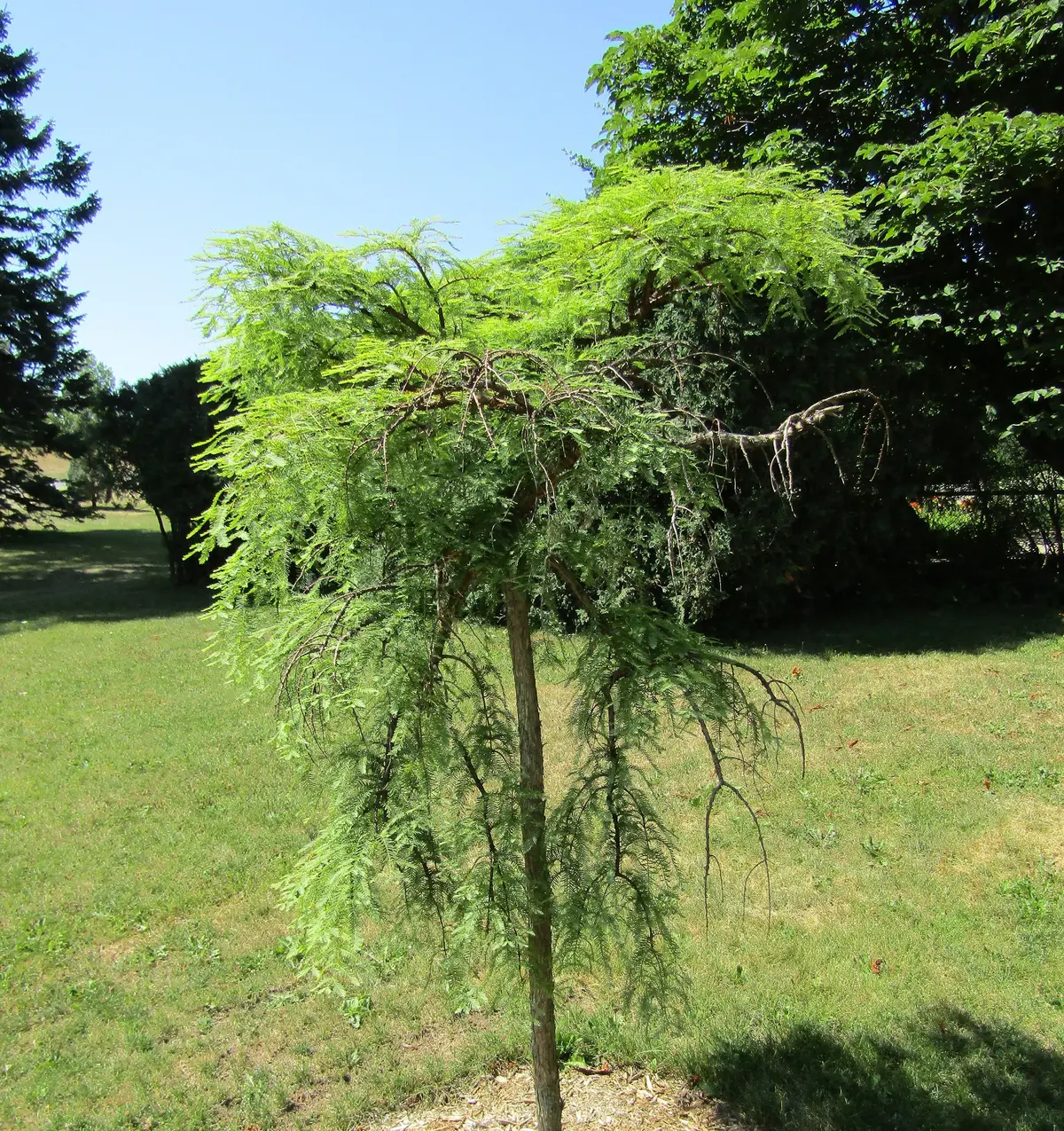
Dawn Redwood 'Miss Grace'
Metasequoia glyptostroboides 'Miss Grace'
A weeping, deciduous 'living fossil' conifer with feathery gray-green needles that turn orange before they drop.
Keep reading Show less
‘Miss Grace’ is a weeping selection of dawn redwood, a deciduous conifer from China that was thought extinct until living trees turned up in the 1940s. Left unstaked, it forms a sprawling mound; trained on a stake, it becomes a small weeping tree, roughly 10 ft tall and 3 ft wide after 10 years.
Through the seasons
Soft, feathery, gray-green needles cover the cascading branches through summer, then turn orange in autumn before the whole tree drops them. In winter the bare, weeping framework takes center stage. The cultivar was found as a witch’s broom in New York and introduced by Buchholz & Buchholz Nursery in Oregon.
Care tips
Give it full sun and moist, well-drained, slightly acidic soil, and keep it watered in dry weather. It transplants easily. Stake the leader if you want a small weeping tree rather than a sprawling mound.
Care sources: Oregon State, NC State Extension.
Pet-safety source: Van den Berk.
Fun Fact
Dawn redwood was known only from fossils until living trees were found in a remote Chinese valley in the 1940s, and unlike most conifers it drops its needles every fall.
Habitat & form
Where it's from and what to expect.
- Native range
- Central and western China (species); cultivated selection
- Plant type
- Tree · Shrub · Perennial · Conifer
- Mature size
- Roughly 10 ft tall and about 3 ft wide after 10 years when staked into a small tree; unstaked it sprawls as a mound or cascading groundcover.
- Bloom
- Not grown for flowers; ornamental value is the weeping habit, feathery summer foliage, and orange fall color.
- Hardiness
- USDA zone 5; sensitive to early freezes.
Care
How to keep it happy.
- Sunlight
- Full sun.
- Water
- Prefers consistently moist soil; tolerates occasional wet soil but not drought. Water deeply during dry spells, especially while establishing.
- Soil
- Moist, deep, well-drained, neutral to slightly acidic soil rich in organic matter; also does well in clay.
- Fertilizer
- No routine fertilizer for healthy, established plants.
- Planting distance
- Allow 4–6 ft of width for a staked specimen; more if left to sprawl.
- Propagation
- Graft or take stem cuttings to preserve the cultivar; seedlings do not come true.
- Pruning
- Needs little pruning. Stake the leader to the height you want, and remove dead or crossing branches in late winter while the tree is leafless.
- Pet safety
- Unknown
Keep pets from chewing.