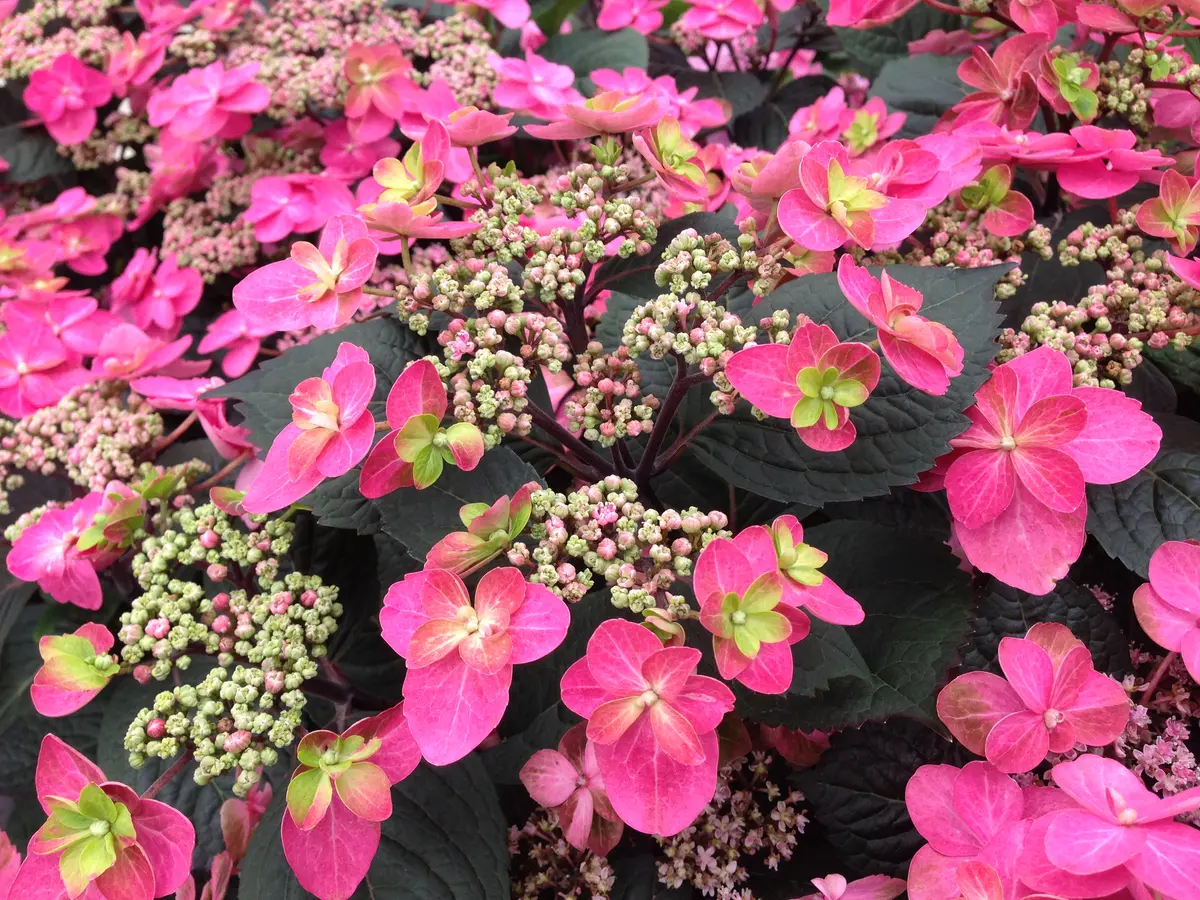
Mountain Hydrangea 'Tuff Stuff™ Red'
Hydrangea serrata 'Tuff Stuff™ Red'
A compact, cold-hardy mountain hydrangea with deep pink-red lacecap flowers that rebloom from early summer into fall.
Keep reading Show less
Mountain hydrangea (Hydrangea serrata) is a compact relative of bigleaf hydrangea, native to Japan and Korea. ‘Tuff Stuff™ Red’ combines the species’ smaller habit and lacecap flowers with improved cold hardiness and repeat blooming.
A long season of flowers
The deep pink-red flower clusters of ‘Tuff Stuff™ Red’ begin opening in early summer on stems carried through winter. The shrub then produces more flowers on new growth, continuing the display into fall. Flower color can shift with soil pH.
Care tips
Plant in rich, moist, well-drained soil in part shade. It can tolerate more sun if the soil remains consistently moist, but protection from hot afternoon sun helps prevent scorching. Little pruning is needed: remove weak or winter-damaged stems in early spring and shape the shrub after flowering only if necessary.
Source: Proven Winners.
Fun Fact
'Tuff Stuff™ Red' is a reblooming mountain hydrangea: its first flowers open on old stems, and later flowers develop on new growth.
Habitat & form
Where it's from and what to expect.
- Native range
- Japan and Korea (species); cultivated selection
- Plant type
- Shrub · Perennial
- Mature size
- 2–3 ft tall and wide.
- Bloom
- Deep pink-red lacecap flowers begin on old wood in early summer and rebloom on new wood through fall; flower color may shift with soil pH.
- Hardiness
- USDA zones 5–9.
Care
How to keep it happy.
- Sunlight
- Part shade; tolerates more sun when soil stays consistently moist, but protect from hot afternoon sun.
- Water
- Medium moisture; water consistently during hot or dry weather.
- Soil
- Rich, moist, well-drained soil.
- Fertilizer
-
Use slow-release shrub fertilizer only when soil is nutrient-deficient.
As spring growth begins
- Planting distance
- 2–3 ft apart.
- Propagation
- Take softwood cuttings in early summer or layer a low branch.
- Pruning
- Little pruning is needed. Remove weak or winter-damaged stems in early spring; shape after flowering if necessary.
- Pet safety
- Mildly toxic
Keep pets from eating leaves or flowers.