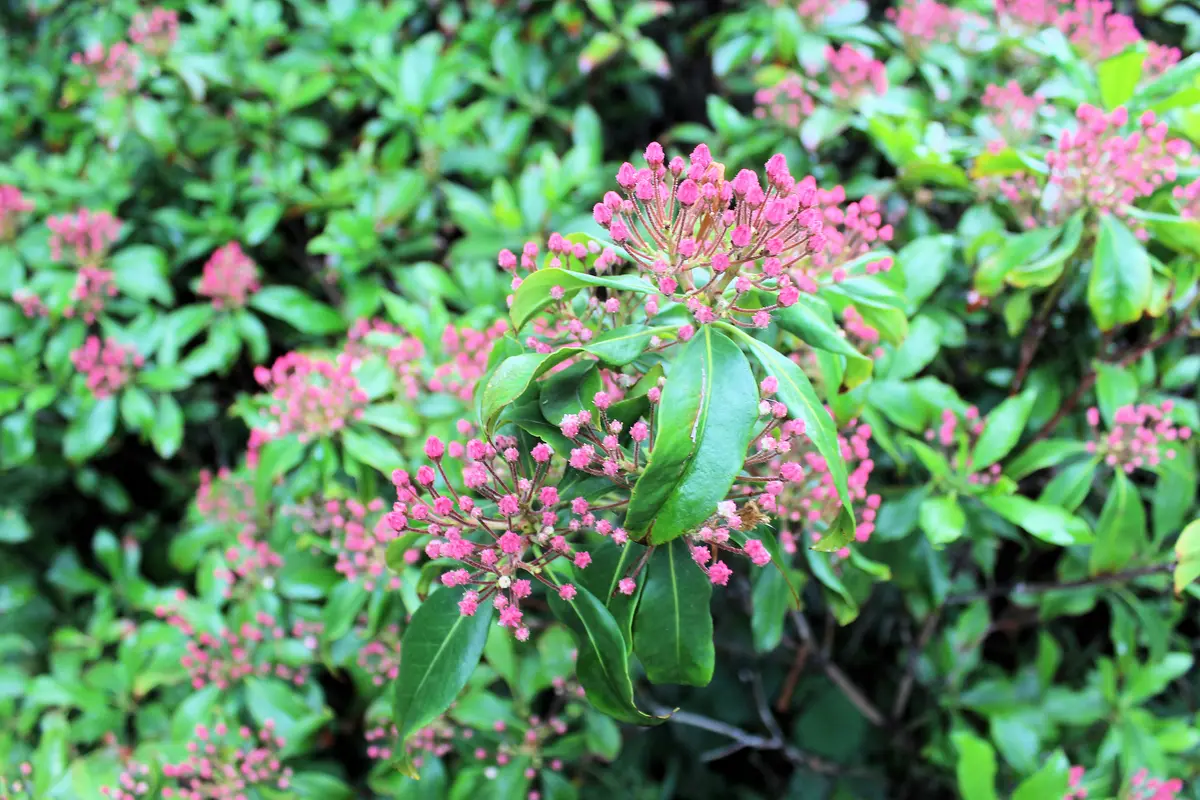
Mountain Laurel 'Carousel'
Kalmia latifolia 'Carousel'
A broadleaf evergreen shrub with glossy foliage and clusters of intricate, cup-shaped flowers banded in cinnamon-pink.
Keep reading Show less
Mountain laurel is a broadleaf evergreen shrub native to eastern North America, where it grows on rocky slopes, acidic woodland margins, and mountain balds. This cultivar keeps the species’ hallmark good looks — leathery, dark green leaves year-round and clusters of elaborately patterned flowers each late spring — in a more compact, garden-friendly size.
Through the seasons
In late spring to early summer, terminal clusters of cup-shaped flowers open from pink buds, each bloom marked on the inside with delicate cinnamon-purple banding. The flowers have a clever mechanical trick: ten anthers are held under tension in small pockets around the corolla, and when a visiting bee brushes one, the filament springs free and flings pollen onto the bee. The glossy, elliptic evergreen foliage stays handsome through the rest of the year, and older plants develop gnarled, twisting trunks that add winter character.
Care tips
Give mountain laurel cool, consistently moist, acidic soil and a spot with morning sun and afternoon shade — the classic woodland-edge conditions it evolved in. It resents heavy clay or waterlogged ground, so improve drainage or plant on a raised bed if needed, and mulch to keep the root zone cool. Prune right after flowering if you want to shape it or remove spent blooms; since next year’s flower buds form on this year’s growth, a late pruning sacrifices the coming display.
Heads up: Every part of this plant is toxic if ingested, and it carries a high flammability rating — keep it out of the defensible space immediately around your home, and keep pets and children from chewing on it.
Fun Fact
Its flowers have spring-loaded anthers tucked into pockets in the petals — when a bee lands and triggers one, the filament snaps outward and dusts the bee with pollen, like a tiny pollen catapult.
Habitat & form
Where it's from and what to expect.
- Native range
- Eastern North America — rocky or sandy woods, meadows, balds, mountain slopes, and acidic woodland margins
- Plant type
- Shrub
- Mature size
- 4–6 ft tall and wide, dense and rounded; the species can eventually reach 6–10 ft.
- Bloom
- Terminal clusters of bell-shaped flowers in late spring to early summer, with distinctive inner purple-pink markings and ten anther pockets.
- Hardiness
- USDA zones 5–9 (some sources cite zone 4 for the species).
Care
How to keep it happy.
- Sunlight
- Best in partial shade (morning sun, afternoon shade); tolerates full sun to full shade, but flowers less in heavy shade.
- Water
- Keep evenly moist, especially while establishing; avoid soggy or waterlogged soil.
- Soil
- Cool, moist, acidic, humus-rich, well-drained soil. Struggles in heavy clay or wet sites — consider a raised planting if drainage is poor.
- Planting distance
- 4–6 ft apart as a specimen or informal mass.
- Propagation
- Semi-hardwood cuttings in midsummer; named cultivars don't come true from seed.
- Pruning
- Deadhead spent flower clusters right after bloom and prune lightly at the same time to encourage bushiness — next year's flowers form on this year's new growth.
- Pet safety
- Highly toxic
All parts including leaves, stems, flowers, nectar and pollen