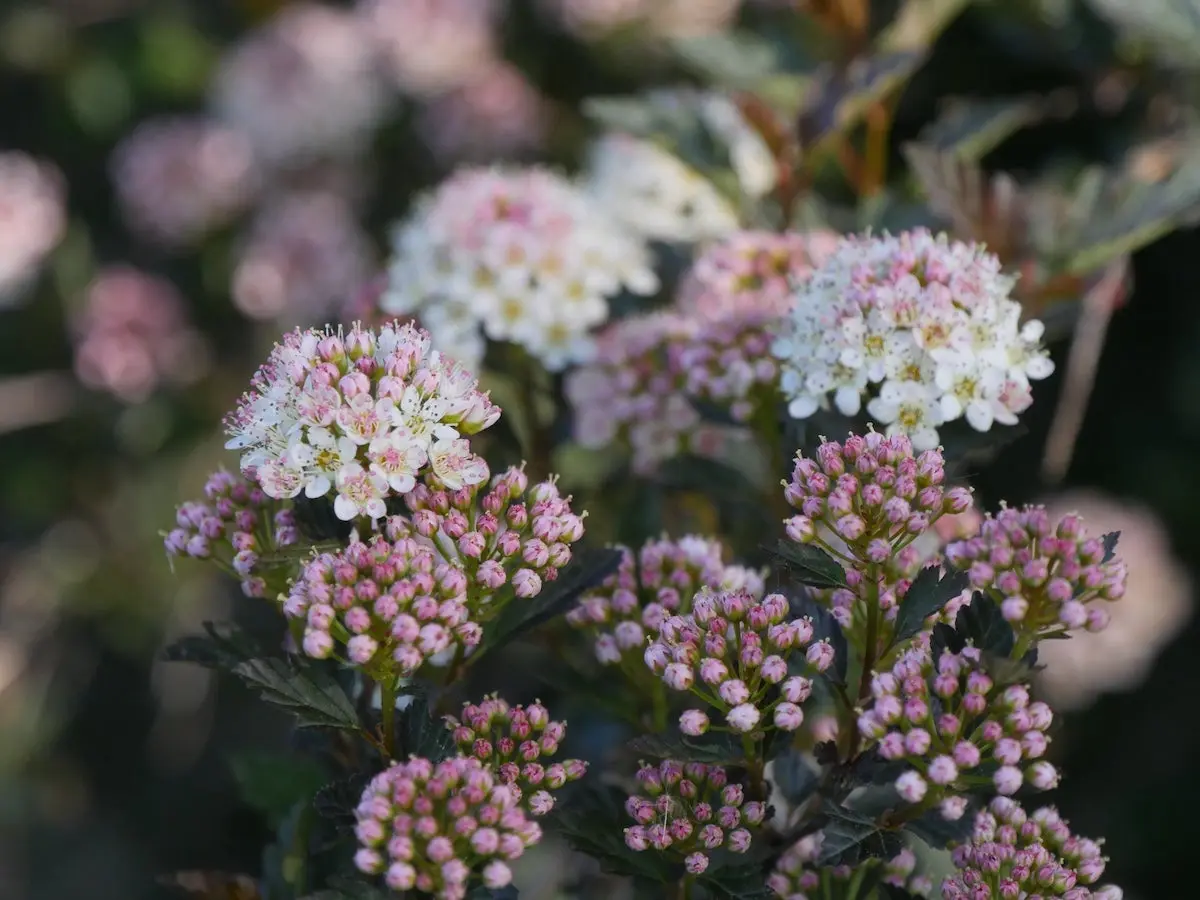
Ninebark 'Tiny Wine'
Physocarpus opulifolius 'Tiny Wine®'
A dwarf native shrub with dark maroon-to-bronze foliage all season, dainty pink-and-white flower clusters, and exfoliating bark.
Keep reading Show less
Ninebark is a tough, adaptable, native deciduous shrub found along stream banks and rocky hillsides across central and eastern North America. This dwarf cultivar packs the species’ best traits — dark, colorful foliage, dainty spring flowers, and shaggy exfoliating bark — into a compact form suited to smaller gardens.
Through the seasons
Small, five-petaled flowers open from darker pink buds into rounded, spirea- like clusters in late spring, standing out against foliage that runs from deep maroon to bronze all season long. The color holds up especially well in full sun. As flowers fade, drooping clusters of reddish seed capsules take over, feeding birds into fall. Once leaves drop, older stems reveal attractive bark that peels away in thin, reddish-brown strips — the source of the plant’s common name.
Care tips
Ninebark is famously low-fuss: it tolerates dry spells, clay soil, and urban conditions with little complaint, and disease resistance (including to powdery mildew) is one of this cultivar’s selling points. Because flowers form on old wood, prune right after blooming rather than in late winter or spring, which would remove the coming season’s buds. An overgrown or tired plant can be cut back hard in late winter to rejuvenate it from the base.
Heads up: Purple- and maroon-leaved ninebark cultivars like this one hold their darkest color with more direct sun — in heavy shade, the foliage fades toward green.
Fun Fact
"Ninebark" comes from its shaggy, exfoliating bark, which peels away in thin layers said to number nine — most visible once the leaves drop in winter.
Habitat & form
Where it's from and what to expect.
- Native range
- Central and eastern North America (species) — rocky banks and streamsides
- Plant type
- Shrub
- Mature size
- 3–5 ft tall and wide.
- Bloom
- Rounded clusters of small white to light pink flowers, opening from darker pink buds, in late spring to early summer.
- Hardiness
- USDA zones 3–7.
Care
How to keep it happy.
- Sunlight
- Full sun for the darkest foliage color and best flowering; tolerates part shade, especially in hot climates.
- Water
- Medium water needs while establishing; drought tolerant once mature. Avoid standing water.
- Soil
- Average, slightly acidic, well-drained soil; tolerates clay, dry, or rocky ground.
- Planting distance
- 3–5 ft apart for a hedge or mass planting.
- Propagation
- Softwood cuttings in early summer.
- Pruning
- Flowers form on old wood, so prune right after blooming (no later than mid-August) if shaping is needed. Can be cut nearly to the ground in late winter to rejuvenate an overgrown plant.
- Pet safety
- Non-toxic