Canadian Hemlock 'Moon Frost'
Tsuga canadensis 'Moon Frost'
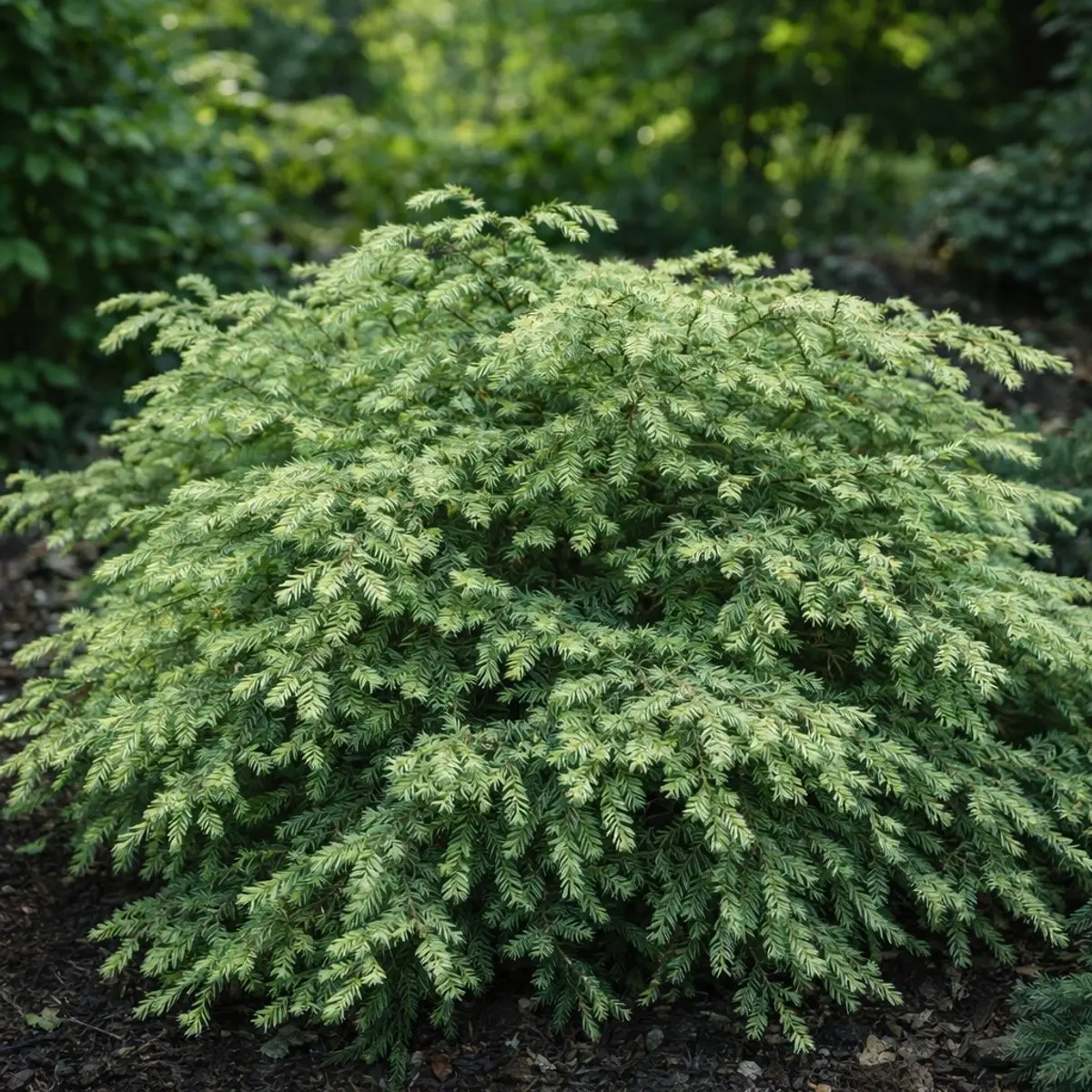
A very slow-growing dwarf hemlock that flushes out bright white new growth each spring over soft green foliage, forming a tidy globe that broadens gracefully with age.
Keep reading Show less
Tsuga canadensis ‘Moon Frost’ is a dwarf Canadian hemlock selected for its bright, glowing new growth — needles emerge nearly white in spring before mellowing to a soft green, giving established plants a two-tone, frosted look that’s especially striking against darker evergreens. Young plants form a tidy, compact globe that gradually broadens into a looser mound with age.
A patient, shade-loving dwarf
Like most dwarf conifer selections, ‘Moon Frost’ grows at a glacial pace — just a few inches a year — so it stays garden-scaled for decades. It prefers a sheltered spot with partial shade, protected from strong wind and the hottest afternoon sun, which can scorch its pale new growth. Give it consistently moist, acidic, well-drained soil and a layer of mulch, since it does not tolerate drought the way many conifers do.
Care tips
Plant where afternoon shade is available, especially in warmer climates, and keep the soil evenly moist rather than letting it dry out. Pruning is rarely needed; if you do want to tidy the shape, do it in late May or June. Avoid roadside or urban sites with heavy pollution, which this species tolerates poorly, and keep an eye out for hemlock woolly adelgid, a serious regional pest of hemlocks in the eastern U.S.
Fun Fact
Each spring, 'Moon Frost' flushes out new growth in a bright, almost luminous white before it settles to a soft green — as if the plant were dusted with frost even in the height of summer. Unlike poison hemlock (an unrelated plant in the carrot family), Tsuga canadensis is not toxic and is even the state tree of Pennsylvania.
Habitat & form
Where it's from and what to expect.
- Native range
- Garden cultivar of the species native to eastern North America, from eastern Canada south to the Appalachian Mountains of Georgia and Alabama
- Plant type
- Conifer
- Mature size
- Extremely slow, growing only 3–6 in. per year; forms a compact globe when young that broadens with age, reaching roughly 6 ft tall and wide over many years.
- Bloom
- None — grown for its evergreen foliage rather than flowers.
- Hardiness
- USDA zone 4 (some sources list zone 3).
Care
How to keep it happy.
- Sunlight
- Partial shade is best, especially with protection from strong wind and hot afternoon sun; tolerates more sun in cooler climates.
- Water
- Keep evenly moist; intolerant of drought. Mulch to conserve soil moisture.
- Soil
- Moist, well-drained, acidic soil (pH about 4.0–6.0).
- Planting distance
- 4–6 ft apart, based on mature spread.
- Propagation
- Semi-ripe cuttings
- Pruning
- Maintenance: very low. Prune only in late May or June if needed to maintain shape; avoid heavy pruning.
- Pet safety
- Non-toxic